
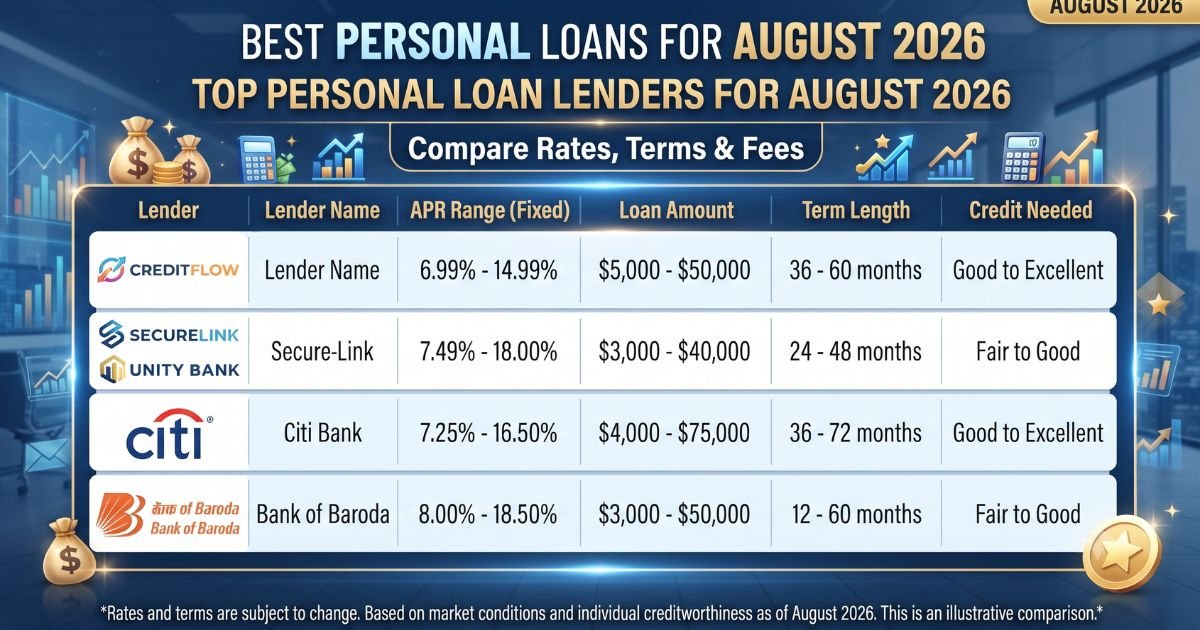
Borrowing money is easy to start and surprisingly difficult to price. Two lenders can offer the same $20,000 loan and still leave you with very different total costs because of APR, fees, repayment terms, and funding speed.
If you are searching for Best personal loans in August 2026, the smartest approach is not to choose a lender simply because it advertises the lowest starting rate. Your actual offer depends on your credit profile, income, existing debts, loan amount, and repayment term.
This guide compares leading options by borrower need, including low-rate loans, bad-credit options, debt consolidation, no-origination-fee products, and fast funding. The goal is to help you compare the numbers before you apply.
Important: Loan rates and terms can change. Always verify the final offer, fees, eligibility requirements, and disclosures directly with the lender before accepting a loan.
Best personal loans of August 2026: Our top picks
There is no single loan that is cheapest or easiest for everyone. Current August 2026 research from Forbes Advisor and WSJ Buy Side shows that lenders differ significantly in rates, fees, loan amounts, credit requirements, and funding speed.
SoFi — Best for large loans and member benefits
SoFi is worth considering for borrowers with strong credit who want a larger unsecured loan and flexible digital management. Forbes Advisor currently lists loan amounts of $5,000 to $100,000, two- to seven-year terms, and APRs from 6.99% to 35.49% with applicable discounts. Forbes also highlights its member benefits and fee structure.
SoFi’s own current disclosures say rates and terms depend on creditworthiness, income, term selection and other factors, and that checking your rate uses a soft credit pull.
Happen Bank — Best for good-credit borrowers
Happen Bank, formerly LendingClub, currently stands out for borrowers with good credit and applicants who may benefit from a co-borrower.
Forbes lists an APR range of 6.53% to 35.99%, loan amounts from $1,000 to $75,000, and repayment terms of two to seven years. An origination fee may apply, so borrowers should evaluate the actual offer instead of looking only at the starting APR.
Upstart — Best for borrowers with fair or limited credit
Upstart can be interesting for borrowers whose financial profile does not fit traditional credit-score-only underwriting.
Current Upstart information explains that its model can consider factors beyond a FICO score, including education and employment history. A 620 score may still qualify for some applicants, although the rate and terms depend on the complete application.
First Tech Federal Credit Union — Best for fast funding
First Tech Federal Credit Union is highlighted by Forbes Advisor for fast funding, with same-day funding available on eligible loans. Membership requirements apply, so borrowers should check eligibility before applying.
PenFed Credit Union — Worth considering for a lower maximum APR
PenFed is notable because Forbes Advisor currently lists a maximum APR of 17.99%, which is considerably below the 30%+ maximums offered by some other lenders. However, your individual rate will depend on your financial profile and the lender’s underwriting decision.
How we compare the Best personal loans in August 2026
A useful comparison should look beyond advertising claims. We focus on six practical factors:
- APR: The annual cost of borrowing, including certain fees.
- Fees: Origination, late-payment and other charges.
- Loan amount: Whether the lender offers enough—or only more than—you need.
- Repayment term: How long you will make payments.
- Eligibility: Credit score, income and other requirements.
- Funding speed: How quickly approved funds may reach your account.
The Consumer Financial Protection Bureau recommends looking at APR and fees when comparing loan products because APR gives borrowers a more useful way to compare overall borrowing costs.
Difference Between Best personal loans of August 2026 and an average loan offer
The biggest mistake borrowers make is assuming the lowest advertised interest rate automatically means the cheapest loan.
Imagine two offers:
Loan A: 9.99% APR with a substantial origination fee
Loan B: 10.49% APR with no origination fee
Loan B could potentially be the better deal depending on the amount and term. That’s why comparing APR, fees, monthly payment and total repayment is more useful than comparing one headline number.
Also consider the repayment period. A longer term can reduce your monthly payment but may increase the amount of interest you pay over the life of the loan.
Personal loan lenders: Banks vs. credit unions vs. online lenders
Personal loan lenders generally fall into three categories.
Banks may be convenient if you already have an account with them. Existing relationships can make account management easier, although they do not automatically guarantee the lowest rate.
Credit unions can offer competitive pricing and member-focused services, but membership restrictions may apply. PenFed and First Tech are examples worth researching.
Online lenders often provide quick applications, rate checks and digital account management. They can be convenient for comparing multiple offers, but borrowers should pay close attention to fees and maximum APRs.
Innovativeblogtech recommends comparing at least three realistic offers before making a final decision. When available, prequalification can help you compare estimated terms without immediately triggering a hard credit inquiry.
Low interest personal loans: How to improve your chances
Low interest personal loans are generally easier to obtain when you have strong credit, stable income and manageable existing debt.
Before applying:
- Review your credit reports for errors.
- Pay down high-interest revolving debt when possible.
- Avoid unnecessary new credit applications.
- Compare offers from multiple lenders.
- Choose a loan term that fits your budget rather than automatically selecting the longest term.
Remember that advertised minimum rates are generally reserved for highly qualified applicants. Your actual rate may be higher.
Best personal loans for bad credit: What should you watch?
Borrowers looking for Best personal loans for bad credit should focus on affordability, not simply approval.
Current August 2026 comparisons show that borrowers with weaker credit can face APRs approaching 36% with some lenders. Universal Credit, Upgrade, Upstart and Avant are among the options highlighted in current bad-credit comparisons.
A loan that is approved quickly but creates an unaffordable monthly payment can make your financial situation worse.
Before accepting a bad-credit loan, calculate:
- Your monthly payment
- Total interest
- Origination fees
- Amount actually deposited into your account
- Total amount repaid
If a secured loan or qualified co-borrower is available, it may improve your options, but understand the risks before using collateral or involving another person.
Debt consolidation loans: When are they worth considering?
Debt consolidation loans combine several existing debts into one new loan and payment.
They can make sense when the new loan has a lower overall cost than the debts you are replacing. For example, someone with several high-interest credit-card balances may prefer one fixed monthly installment if the new APR and fees are substantially lower.
However, don’t judge consolidation by monthly payment alone.
A longer repayment term can reduce your monthly bill while increasing total interest. You should compare:
Current debt cost → New APR → Fees → New term → Total repayment
Also avoid rebuilding credit-card balances after paying them off. Otherwise, you could end up with both the consolidation loan and new revolving debt.
Personal loans with no origination fee: Why it matters
An origination fee is a charge that may be deducted from the amount you receive or added to the borrowing cost.
For example, if you apply for a $20,000 loan with a 5% origination fee, the amount you actually receive could be $19,000 while your loan obligation is based on the lender’s agreement.
That’s why Personal loans with no origination fee can be attractive when other terms are similar.
SoFi currently markets no origination fees on some of its personal-loan offerings, while its disclosures also make clear that rates and terms can vary by applicant and product. Always review the specific offer you receive.
The CFPB also advises borrowers to check loan disclosures for fees before agreeing to a personal installment loan.
Same-day personal loans and Instant approval loans: Don’t confuse speed with value
Same-day personal loans can be useful when you need funds quickly, but same-day funding does not mean guaranteed approval.
Funding speed can depend on application time, verification, approval, banking processes and whether all required documents are complete.
Similarly, Instant approval loans should not be judged only by how quickly the decision appears. A fast approval with a very high APR can be much more expensive than a slightly slower loan with better terms.
Current August 2026 comparisons identify lenders such as SoFi, Rocket Loans and First Tech among options associated with fast funding.
Unsecured personal loans vs. secured loans
Unsecured personal loans do not require you to pledge a specific asset as collateral.
That makes them convenient, but lenders may compensate for the additional risk through their underwriting and pricing.
Secured loans use collateral such as a vehicle or another eligible asset. They may sometimes offer better terms, but failing to repay can put the pledged asset at risk.
The right choice depends on your financial position, not simply the advertised interest rate.
Best personal loans companies: A simple comparison method
When comparing Best personal loans companies, don’t rank them purely by brand recognition.
Use this checklist:
| Factor | What to compare |
| APR | Your actual offered APR |
| Fees | Origination, late and other charges |
| Loan amount | Minimum and maximum |
| Term | Total repayment period |
| Credit | Minimum score and eligibility |
| Funding | Expected funding time |
| Flexibility | Co-borrower, discounts and creditor payment |
| Support | Customer service and account tools |
The lender that looks best on a comparison website may not provide the best offer for your specific financial profile.
Top personal loan banks: Are banks always cheaper?
Top personal loan banks can be useful, particularly if you already have an established banking relationship.
But being a bank does not automatically mean the lender will offer the lowest APR.
Credit unions and online lenders may compete strongly on rates, fees, repayment terms and digital convenience. Compare the actual offers rather than assuming one type of lender is always better.
Compare personal loan rates before applying
If you want to compare personal loan rates, collect multiple prequalified offers where possible.
Look at the APR first, then examine:
- Origination fees
- Monthly payment
- Repayment term
- Total repayment
- Funding time
- Prepayment rules
The CFPB notes that APR is useful for comparing borrowing costs because it incorporates interest and certain fees.
A little application etiquette also matters: apply only when you’re ready, read the disclosures, and avoid submitting unnecessary duplicate applications.
Minimum credit score for personal loan approval
There is no universal minimum credit score for personal loan approval.
Lenders can consider your credit history, income, existing debts, loan amount, repayment term and other factors.
For example, current research shows that some lenders may work with applicants around the high-500s or 600s, while others target stronger credit profiles. Upstart says its underwriting can consider factors beyond the traditional FICO score.
If your score is lower, avoid applying everywhere at once. Target lenders whose eligibility criteria are realistic for your profile.
Monthly payment calculator: Check affordability before signing
A monthly payment calculator can turn an attractive loan advertisement into a realistic budget decision.
Enter:
- Loan amount
- APR
- Repayment term
Then compare the estimated payment with your actual monthly budget.
Try different terms as well. A longer term may reduce the monthly payment, while a shorter term may reduce the overall interest cost.
For finance websites, a useful calculator can also make an article more practical and help attract free organic traffic because visitors can complete a real task instead of simply reading promotional content.
Innovativeblogtech recommends using a calculator as a planning tool, but the lender’s final disclosure should always be used for the exact payment and total cost.
7 questions to ask before accepting a personal loan
Before signing, ask:
- What is my exact APR?
- How much will I actually receive after fees?
- What will I repay in total?
- Is the monthly payment comfortable?
- Is there an origination fee?
- Can I repay early without a penalty?
- Is there a cheaper alternative?
Depending on the reason for borrowing, alternatives could include savings, a credit-union product, a promotional credit-card offer, employer assistance or another financing option.
Final verdict: Choose the loan that fits your finances
The best borrowing decision is not necessarily the loan with the lowest advertised rate. It is the offer that gives you a manageable payment, reasonable total cost, suitable repayment period and terms you fully understand.
SoFi may appeal to borrowers looking for larger loans and member benefits. Happen Bank can be worth researching for good-credit borrowers and co-borrowers. Upstart may be useful for applicants with less traditional credit profiles. First Tech stands out for fast funding, while PenFed deserves attention for its lower maximum APR in current comparisons. These are starting points for research—not guarantees of approval or pricing.
For anyone comparing Best personal loans, the most important step is to look at the complete offer rather than the headline rate. Check the APR, fees, payment, term and total repayment before you commit.
Innovativeblogtech’s goal is to make financial comparisons easier to understand so readers can make more informed borrowing decisions.
Frequently Asked Questions
1. What is a good APR for a personal loan in August 2026?
A good APR depends on your credit profile, income, loan amount and term. Current August 2026 comparisons show advertised rates starting in the mid-single digits for highly qualified borrowers, while higher-risk borrowers can face rates near 36%.
2. Can I get a personal loan with bad credit?
Yes. Some lenders consider applicants with weaker credit profiles. However, approval does not automatically mean the loan is affordable. Compare the APR, fees, monthly payment and total repayment before accepting an offer.
3. Are debt consolidation loans a good idea?
They can be useful when the new loan has a lower overall cost than your existing debts and you can avoid accumulating new debt. Always compare the new APR, fees and repayment period.
4. Are same-day personal loans legitimate?
Yes, legitimate lenders can offer fast funding. However, “same-day” refers to the potential funding timeline, not guaranteed approval. Always check the lender’s official terms, fees and eligibility requirements.
5. Does checking personal loan rates hurt my credit score?
Many lenders offer prequalification using a soft credit inquiry, which generally does not affect your score in the same way as a hard inquiry. A formal application can involve a hard inquiry, so check the lender’s disclosure before applying.
Bottom line: Compare APR, fees, repayment term and total cost—not just the monthly payment or advertised starting rate. A loan is only a good fit when the complete cost works for your budget.




1 thought on “Best Personal Loans for August 2026: Compare Rates, Fees & Top Lenders”