The biggest financial threat in 2026 may not be a bad investment, a market crash, or an unexpected expense. It may be a message that looks completely legitimate.
A text that appears to come from your bank. A phone call from someone claiming to be a fraud investigator. An investment opportunity shared by someone you trust. Or even a video or voice message that appears to come from a colleague or family member.
These are no longer isolated scams. Digital fraud has become a sophisticated financial threat, and the numbers show just how serious the problem has become.
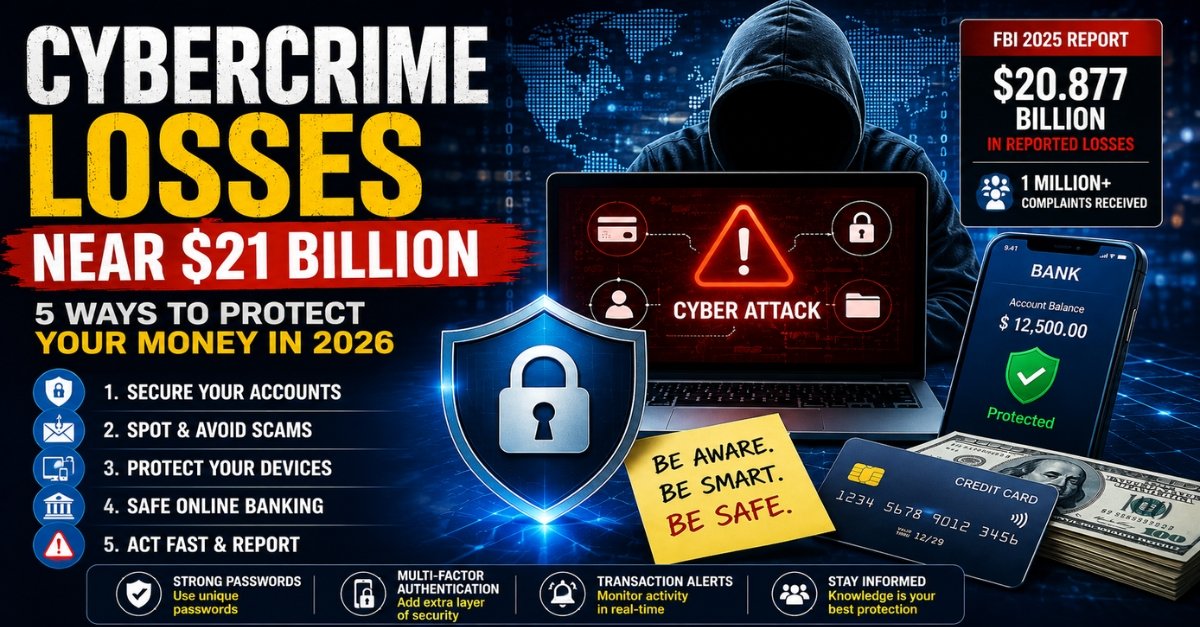
The FBI’s 2025 Internet Crime Report recorded $20.877 billion in reported losses, compared with $16.6 billion in 2024. More than one million complaints were submitted to the FBI’s Internet Crime Complaint Center (IC3) during 2025.
That makes cybercrime losses near $21 billion more than just a frightening headline. It is a warning that protecting your money now requires more than simply having a strong password.
The good news? You don’t need to become a cybersecurity expert to significantly reduce your risk.
You need a few smart habits, the right security settings, and a plan for what to do when something feels wrong.
In this guide, we’ll explore five practical ways to protect your money in 2026—from everyday banking to business finances.
Why Cybercrime Losses Near $21 Billion Should Matter to Everyone
When people hear the word “cybercrime,” they often imagine someone breaking into a computer using complicated technical tools.
Today’s financial attacks frequently work differently.
Instead of attacking technology first, criminals often attack human trust.
They may impersonate a bank employee, company executive, government official, investment adviser, delivery company, friend, or even a family member. The goal is to make the victim act quickly before they have time to question what is happening.
The FBI reported that phishing/spoofing, extortion, and personal data breaches were among the most frequently reported internet crimes, while investment fraud remained one of the most financially damaging categories.
The FTC’s 2025 data also shows how convincing impersonation has become: consumers reported losing approximately $3.5 billion to imposter scams in 2025.
For businesses, the danger can be even greater. One compromised employee account can potentially expose invoices, payroll information, customer data, payment systems, and internal communications.
The lesson is simple:
Your money doesn’t always need to be “hacked” to be stolen. Sometimes criminals only need to convince you to send it yourself.
1. How to Protect Your Money From Cybercrime With Multi-Layer Security
The first rule of financial security in 2026 is simple: never rely on one security barrier.
A password alone is not enough.
Even a long, complicated password can become useless if it is exposed through a data breach, phishing page, malware, or reused account.
Instead, build multiple layers around your financial accounts.
Turn on multi-factor authentication everywhere
Multi-factor authentication (MFA) requires an additional verification step after your password.
Depending on the service, this could be:
- An authenticator app
- A security key
- A biometric check
- A verification prompt
- A one-time code
For your most important accounts, prioritize stronger authentication methods where available.
Start with:
- Primary email
- Bank accounts
- Investment accounts
- Payment services
- Cryptocurrency accounts
- Business financial accounts
- Cloud storage containing financial documents
Your email deserves special attention because it can act as the reset key for many other accounts.
If a criminal takes control of your email, they may be able to reset passwords elsewhere.
Stop reusing passwords
Create a different password for every important account.
A password manager can make this practical because you don’t have to memorize dozens of unique passwords.
This isn’t about making your life more complicated. It is about preventing one stolen password from becoming a master key.
2. Cybercrime Protection Tips: Build a Financial Safety Net
Security isn’t only about preventing an attack.
It is also about limiting the damage if something goes wrong.
One of the smartest cybercrime protection tips is to separate your digital financial life into layers.
For example, you might use:
- One account for everyday spending
- Another account for savings
- A separate account for business transactions
- A dedicated card for online purchases
- A separate email address for financial services
This creates boundaries.
If your everyday debit card is compromised, your entire savings balance doesn’t automatically become exposed.
Protect bank accounts from hackers with transaction controls
Many banks and financial platforms provide controls that users overlook.
Look for features such as:
- Instant transaction alerts
- Card freeze/unfreeze
- Spending limits
- International transaction controls
- ATM withdrawal controls
- Login notifications
- New-device alerts
- Beneficiary-change notifications
Turn them on.
A $500 suspicious transaction discovered within minutes is a very different problem from discovering it three weeks later.
Also review your accounts regularly.
You don’t need to obsessively check your balance every hour. A scheduled weekly review is usually enough to spot unfamiliar activity before it becomes a much bigger issue.
Keep emergency savings separate
Your financial safety net should not depend entirely on the same account you use for online purchases and daily transactions.
The objective is simple:
Make it difficult for one compromised account to become a total financial disaster.
3. How to Protect Money From Online Scams When AI Makes Fraud More Convincing
Artificial intelligence has changed the economics of online fraud.
Criminals can now create more convincing messages, websites, images, audio, and videos at scale.
The FBI’s 2025 report specifically highlighted cryptocurrency and artificial intelligence-related complaints among the costliest areas of cyber-enabled fraud.
That means traditional advice such as “look for spelling mistakes” is becoming less reliable.
AI Scams and Cybercrime: Don’t Trust Familiar Voices
Imagine receiving a voice message that sounds exactly like your business partner.
They tell you:
“I’m stuck in a meeting. Please transfer the payment immediately.”
Would you send the money?
In 2026, you shouldn’t approve a significant financial transaction based solely on a voice, video, email, or text message.
Instead, introduce a verification pause.
For unusual financial requests:
- Stop.
- Do not click the supplied link.
- Do not reply to the message.
- Open the official app or website yourself.
- Contact the person using a previously known phone number.
- Confirm the payment independently.
This is particularly important for business owners.
A finance employee receiving an urgent payment request from a CEO should not treat familiarity as authentication.
Create a company rule:
Large or unusual payments require independent verification.
That single process can prevent a surprisingly expensive mistake.
4. Cybersecurity Tips to Protect Your Finances: Secure the Devices Behind Your Money
Your bank may have excellent security.
But if the device you use to access the bank is compromised, the situation changes.
Your laptop, phone, browser, and email account all form part of your financial security system.
Keep your operating system and apps updated
Security updates frequently address vulnerabilities that criminals may exploit.
Turn on automatic updates wherever practical.
Also update:
- Web browsers
- Banking apps
- Password managers
- Security software
- Mobile operating systems
- Business application
CPLForge
Don’t treat update notifications as annoying interruptions. They are often part of your defensive infrastructure.
Be careful with browser extensions
A browser extension can have significant access to your online activity.
Remove extensions you no longer use and only install software from trusted sources.
The same principle applies to mobile applications.
Before installing an app that requests access to contacts, messages, files, or accessibility functions, ask yourself:
Does this app genuinely need this permission?
If the answer is no, don’t grant it.
Avoid financial activity on public computers
Public Wi-Fi is not automatically dangerous, but sensitive financial activity becomes riskier when you combine an unfamiliar network with an unfamiliar or shared device.
For important transactions, use a trusted device with current software and your own secure connection.
5. Financial Cybercrime Prevention: Create a 15-Minute Response Plan
Even careful people can become victims.
That doesn’t mean your security strategy failed.
The difference between a manageable incident and a devastating one can be how quickly you respond.
Create your response plan before you need it.
What to do if you think you’ve been scammed
If you notice an unauthorized transaction or believe you have shared sensitive information:
Step 1: Contact your financial institution immediately.
Ask what actions can be taken to stop, reverse, freeze, or investigate the transaction.
Step 2: Secure the compromised account.
Change passwords and revoke suspicious sessions or devices.
Step 3: Secure your email.
If an attacker could access your email, change its password and review recovery information and forwarding rules.
Step 4: Preserve evidence.
Keep screenshots, transaction records, emails, phone numbers, website addresses, receipts, and messages.
Step 5: Report the incident.
For U.S. internet crime, the FBI’s IC3 accepts complaints and uses submitted information to identify patterns and support investigations.
Don’t assume that reporting is pointless because the amount was small.
Reports help authorities understand emerging patterns, and the FBI notes that submitted IC3 information can contribute to investigations and, in some cases, efforts to freeze stolen funds.
Why speed matters
Consider two scenarios.
In the first, someone notices a suspicious $300 transaction and contacts the bank immediately.
In the second, the same person notices it after several weeks.
The underlying fraud may be identical, but the opportunity to intervene can be very different.
Fast detection is therefore part of financial security.
Online Scams and Cybercrime: The Five-Second Rule
Here’s a simple habit anyone can adopt.
When a message involves money, passwords, account access, investments, or urgent action, pause for five seconds.
Ask:
“Why is this person asking me to act immediately?”
Scammers frequently create artificial urgency.
They may say:
- “Your account will be closed today.”
- “Your payment has failed.”
- “Your computer is infected.”
- “You have won a prize.”
- “Your investment opportunity expires tonight.”
- “Your boss needs this transfer immediately.”
Urgency reduces critical thinking.
A five-second pause creates room to verify.
That tiny habit can be more valuable than memorizing hundreds of cybersecurity rules.
Financial Cybercrime Is Also a Business Risk
Business owners face a different version of the same problem.
A company may have firewalls, endpoint protection, security policies, and IT professionals—but an attacker can still target an employee’s judgment.
Business email compromise, fake invoices, supplier impersonation, payroll fraud, and account takeover can turn a normal communication into a financial incident.
That’s why companies should create financial verification procedures, not just technical cybersecurity policies.
For example:
A simple business payment policy
Any payment that is:
- unusually large,
- sent to a new bank account,
- requested urgently,
- different from normal supplier behavior, or
- initiated through an unusual communication channel
should receive independent confirmation.
Don’t verify using the same email thread that requested the payment.
Call the supplier or employee through a trusted contact method.
For growing businesses, this process is particularly important because informal communication habits often continue long after the company has become financially significant.
Technology company Innovativeblogtech & Cplforge can also use this principle when developing or reviewing digital workflows: security should be designed around how people actually behave, not just around how software is supposed to work.
Why Traditional Security Advice Isn’t Enough in 2026
The cybersecurity conversation used to focus heavily on passwords, antivirus software, and avoiding suspicious links.
Those remain important.
But modern financial fraud increasingly combines technology + psychology + personal information.
A scammer may already know your name, employer, approximate location, financial interests, or professional relationships.
They can then use that information to construct a believable story.
This is why the best defense isn’t simply “be more careful.”
It is to create systems that make mistakes harder to execute.
For individuals, that means:
- MFA
- Account separation
- Transaction alerts
- Device updates
- Independent verification
- Fast reporting
For businesses, add:
- Payment approval workflows
- Employee training
- Vendor verification
- Role-based access
- Backup procedures
- Incident-response plans
The objective isn’t perfect security.
The objective is controlled risk.
What the $21 Billion Number Really Tells Us
The FBI’s $20.877 billion figure represents reported losses from complaints submitted to IC3—not every financial loss suffered by every victim.
That distinction matters.
Not every victim reports a crime.
Some people don’t know where to report it. Others are embarrassed. Some may not realize they have been targeted.
The FTC similarly notes that reported fraud represents only part of the problem because many scams are never reported.
So the headline number should not make people panic.
It should make people change their habits.
The most important question isn’t:
“Could I become a victim?”
It is:
“If someone targeted me tomorrow, how difficult would I make it for them to take my money?”
If your answer is “not very difficult,” start with the five steps above.
Final Takeaway: Protect the Money Before You Have to Recover It
The modern financial threat landscape rewards speed, trust, and distraction.
Attackers don’t necessarily need sophisticated access to your computer. Sometimes they only need you to click, approve, transfer, or share something before you stop and verify.
The rise in cybercrime losses near $21 billion shows that digital fraud is no longer a niche cybersecurity issue. It is a mainstream financial risk.
But protection doesn’t have to be complicated.
Start today:
1. Enable MFA on your financial accounts.
2. Separate everyday spending from important savings.
3. Treat unexpected financial requests as unverified until independently confirmed.
4. Keep your devices, browsers, and apps updated.
5. Have a response plan ready before an incident happens.
For individuals and businesses alike, the goal isn’t to eliminate every possible threat.
It’s to make your money harder to reach, harder to manipulate, and faster to protect when something goes wrong.
That mindset is becoming one of the most valuable forms of financial discipline in 2026.
Innovativeblogtech believes that practical digital awareness should be part of modern financial literacy—not something people learn only after losing money.
Because when online fraud becomes more convincing, your best defense isn’t fear. It’s preparation.
FAQs About Cybercrime and Protecting Your Money
1. What are cybercrime losses near $21 billion based on?
The figure comes from the FBI’s 2025 Internet Crime Report, which recorded approximately $20.877 billion in reported losses from internet crime complaints submitted to IC3. It is important to understand that this represents reported losses, not every cybercrime loss that occurred.
2. How can I protect my money from cybercrime?
Start with multi-factor authentication, unique passwords, transaction alerts, regular account monitoring, updated devices, and independent verification of unexpected payment requests. Never rely solely on a message, phone call, voice recording, or email to confirm a financial transaction.
3. Are AI scams becoming more dangerous?
Yes. AI can make fraudulent messages, fake identities, voice impersonation, and other social-engineering techniques more convincing and scalable. The FBI’s 2025 report specifically identified AI-related complaints among significant areas of cyber-enabled fraud.
4. What should I do if I accidentally send money to a scammer?
Contact your bank or payment provider immediately and explain that the transaction may be fraudulent. Secure the affected accounts, preserve evidence, change compromised credentials, and report the incident to the appropriate authorities. For U.S. internet crime, you can submit a report through the FBI’s IC3.
5. What is the biggest cybersecurity mistake businesses make with financial transactions?
One major weakness is trusting the communication channel instead of independently verifying the request. A legitimate-looking email or message should not automatically authorize a large or unusual payment. Businesses should establish independent verification procedures for new beneficiaries, unusual invoices, urgent transfers, and changes to supplier payment details.