
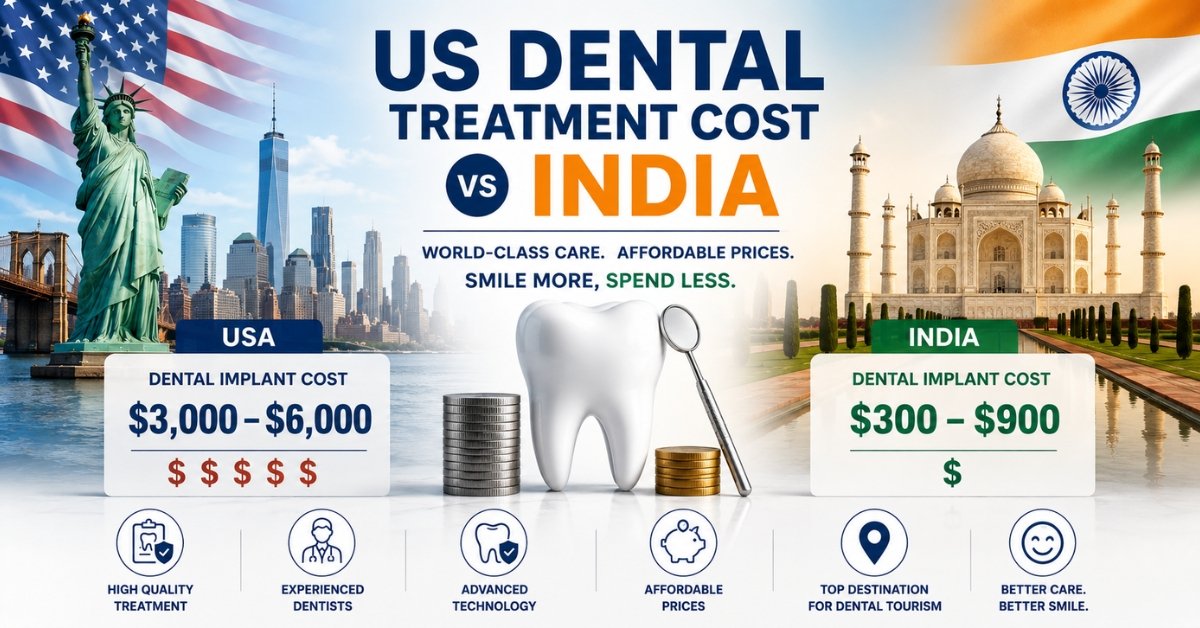
A dental problem that might seem routine can become a major financial shock when it happens in the United States. For many Indians living in America, the difference becomes especially noticeable when they compare a single dental bill with what similar treatment could cost in India.
A recent example involving an NRI facing a bill of around ₹2.37 lakh for treatment of one tooth has once again highlighted the huge difference between dental expenses in the two countries. What may cost a fraction of that amount in India can become a four-figure expense in the US, particularly when consultation, imaging, anesthesia, specialist fees and other charges are added.
The issue is bigger than one patient’s bill. It raises an important question for NRIs, international workers, students and families: why is dental care so expensive in America, and when does traveling to India for treatment actually make financial sense?
This US dental treatment cost vs India comparison looks at extraction costs, insurance, healthcare expenses, travel considerations and the practical decisions NRIs should make before choosing where to receive dental treatment.
US Dental Costs vs India: Why One Tooth Can Cost ₹2.37 Lakh
The first thing to understand is that dental pricing in America doesn’t usually represent one single charge.
A patient visiting a dentist may receive separate charges for the examination, X-ray, consultation, extraction, anesthesia, medication or follow-up appointment. If the case is complicated, a specialist may also become involved.
That is why a seemingly straightforward procedure can turn into a surprisingly large US dentist bill.
A reported bill of approximately ₹2.37 lakh is particularly eye-catching for Indian readers because dental procedures that cost thousands of dollars in America can often be considerably cheaper in India.
$2,500 Tooth Extraction: Is It Really Possible?
A $2,500 tooth extraction sounds extraordinary to someone familiar with Indian dental prices. However, the final amount charged in the US can depend heavily on the type of extraction, location, provider, insurance coverage and additional procedures.
A basic extraction is different from a complicated surgical extraction. A patient may also need diagnostic imaging, sedation, bone-related procedures or specialist care.
Therefore, patients should not assume that every tooth extraction in America costs $2,500. Instead, the example demonstrates how quickly American dental expenses can rise when multiple services are included.
US Dentist Cost for Tooth Extraction vs India
The US dentist cost for tooth extraction varies considerably depending on whether the procedure is simple or surgical.
A straightforward extraction can be relatively affordable compared with more complex procedures. Surgical extraction, impacted wisdom teeth, specialist involvement and sedation can increase the final bill substantially.
In India, dental clinics generally operate with lower overhead expenses, including staffing, property costs and operating expenses. Those differences can translate into lower treatment prices.
This is one reason tooth extraction cost in USA often appears dramatically higher when compared with private dental clinics in major Indian cities.
Tooth Extraction Cost in India
The tooth extraction cost in India can vary according to the city, clinic, dentist’s experience and complexity of the procedure.
For many patients, however, routine dental procedures remain considerably more affordable than equivalent private treatment in the United States.
India also has a large network of private dental clinics, dental hospitals and specialist centers. In metropolitan cities, patients can find dentists offering modern diagnostic equipment and specialized treatment.
The important point is that patients should compare like-for-like procedures. A simple extraction should not be compared with a surgical extraction, and a basic clinic consultation should not be compared with a specialist hospital visit.
NRI Dental Treatment Cost: Why NRIs Feel the Difference More
The NRI dental treatment cost question is particularly important because NRIs often earn in dollars but still remember the relative affordability of healthcare in India.
Someone who has lived in India may be accustomed to paying a relatively modest amount for routine dental treatment. After moving to America, the same person may discover that even visiting a dentist can involve significant out-of-pocket expenses.
This difference becomes more important when several family members require treatment.
For example, one person may need an extraction while another requires a filling, crown or root canal. Suddenly, dental care becomes a household budgeting issue rather than an occasional medical expense.
NRI Shocked by US Dental Bill
The phrase NRI shocked by US dental bill captures a common reaction to unexpectedly high American healthcare charges.
The surprise isn’t necessarily because American dentists are overcharging. The healthcare system itself operates differently. Dental practices must cover higher labor costs, rent, equipment, insurance, administration and regulatory expenses.
Insurance also works differently from what many Indians are familiar with.
A patient who assumes that having dental insurance means the entire procedure will be covered can be disappointed when they discover deductibles, annual limits, copayments or exclusions.
US Dental Treatment Cost vs India: Where the Biggest Difference Appears
The biggest difference becomes visible when comparing routine procedures with complex treatments.
In India, patients can often access dental care at a relatively lower price because operating and labor costs are lower. In the US, healthcare providers operate in a much more expensive business environment.
That does not automatically mean India provides better treatment or America provides worse treatment. Quality depends on the individual dentist, clinic, equipment, diagnosis and treatment plan.
For patients researching dental treatment cost in America, the correct question should therefore be:
What is the total cost for the same procedure, with the same level of expertise and after accounting for insurance?
India vs USA Dental Treatment
The India vs USA dental treatment debate is not simply about choosing the cheapest dentist.
Patients should compare:
- Dentist qualifications
- Treatment complexity
- Diagnostic tests
- Clinic standards
- Materials used
- Specialist involvement
- Insurance coverage
- Follow-up requirements
- Travel expenses
- Recovery time
A cheaper treatment is not necessarily the better choice if the patient needs multiple follow-up visits or has a complicated dental condition.
Dental Insurance in USA: The Missing Piece in Many Comparisons
One of the biggest factors affecting dental expenses is dental insurance in USA.
Dental insurance can reduce the patient’s out-of-pocket cost, but coverage varies widely. Some plans cover preventive care generously while offering limited coverage for major procedures.
Patients may also encounter:
- Deductibles
- Copayments
- Coinsurance
- Annual maximums
- Waiting periods
- Network restrictions
- Procedure-specific limitations
Before agreeing to expensive treatment, an insured patient should ask the dental office for an estimate of the expected out-of-pocket amount.
This is particularly important for procedures involving crowns, root canals, implants or oral surgery.
Healthcare Costs in USA: Why Dental Bills Feel So High
Dental expenses are part of the larger healthcare costs in USA discussion.
American healthcare prices can be difficult for international residents to understand because the amount paid by the patient may depend on insurance negotiations, provider networks and the exact services billed.
The same procedure can potentially produce different out-of-pocket costs depending on the patient’s insurance plan and provider.
For an NRI, the comparison can be even more dramatic because the reference point is often Indian healthcare pricing.
The difference explains why US healthcare cost for Indians has become a growing concern for families planning long-term life in America.
US Healthcare Expenses and Family Budgets
Unexpected dental treatment can disrupt a household budget.
A family may plan its monthly expenses around rent, food, transportation and insurance premiums. A sudden $1,500 or $2,500 dental bill can then create an additional financial burden.
For this reason, dental care should not be treated as an expense that can always be postponed.
Preventive checkups may help identify problems before they become expensive emergencies.
Affordable Dental Treatment India: Why NRIs Consider Returning Home
The idea of affordable dental treatment India is one reason some NRIs consider receiving non-emergency treatment during visits home.
India has become an important destination for people seeking comparatively lower-cost medical and dental services.
The decision becomes particularly attractive when a person already plans to visit India for family reasons. In such cases, the incremental travel cost associated with dental treatment may be relatively small.
However, traveling solely for a dental procedure requires more careful calculation.
Flight to India for Dental Treatment: Does It Save Money?
A flight to India for dental treatment can make financial sense in some situations, but not in every case.
Suppose an NRI needs a minor procedure that costs several hundred dollars in America. Flying thousands of miles for treatment may not make economic sense once airfare, accommodation, transportation and lost workdays are included.
The calculation changes for expensive, non-urgent procedures requiring multiple appointments.
Patients should compare:
US treatment cost
versus
India treatment cost + airfare + accommodation + local transportation + time away from work
Only then can they determine whether traveling is genuinely cheaper.
Dental Care Cost Comparison: What NRIs Should Calculate
A proper dental care cost comparison should include the complete treatment journey rather than the advertised procedure price.
For example, someone comparing a dental implant should consider consultation, imaging, extraction if necessary, implant placement, crown, medications and follow-up.
Similarly, an extraction may involve more than the extraction itself.
A useful comparison checklist includes:
| Cost Factor | USA | India |
|---|---|---|
| Dentist consultation | Compare provider rates | Compare clinic rates |
| Diagnostic imaging | Check insurance coverage | Check clinic pricing |
| Procedure | Depends on complexity | Usually lower-cost |
| Specialist fee | May add substantially | Depends on specialist |
| Insurance | Can reduce out-of-pocket cost | Usually self-pay |
| Travel | Local transportation | International travel may apply |
| Follow-up | Convenient if treated locally | Requires planning if returning to US |
This approach gives a much more realistic picture than comparing one headline price.
India Dental Treatment Prices: Why They Vary
India dental treatment prices are not identical across the country.
Treatment in a premium metropolitan clinic may cost significantly more than treatment at a smaller local practice. Dentist experience, technology, materials and location all influence pricing.
For NRIs, another factor is the type of clinic selected.
A low-cost clinic isn’t automatically the best option. Patients should look at qualifications, hygiene standards, diagnostic facilities, treatment reviews and transparent pricing.
The goal should be value, not simply the lowest possible bill.
Medical Tourism India and the Dental Opportunity
Medical tourism India has grown partly because international patients can access a broad range of healthcare services at comparatively competitive prices.
Dental treatment can be part of this trend.
India has internationally trained dentists, specialist hospitals and private clinics serving both domestic and international patients. Some clinics specifically offer treatment packages for overseas patients.
But patients considering treatment abroad should remember that dental procedures are still medical procedures. Diagnosis and quality should come before price.
NRI Life in America: Planning for Healthcare Costs
For people considering long-term NRI life in America, healthcare budgeting should be part of financial planning.
Dental expenses are often overlooked because people focus on health insurance and emergency medical coverage.
Yet dental treatment can create substantial out-of-pocket expenses.
An NRI household can reduce surprises by:
- Understanding its dental insurance policy.
- Finding an in-network dentist.
- Requesting written treatment estimates.
- Maintaining regular dental checkups.
- Comparing non-emergency treatment options.
- Planning elective treatment during India visits when appropriate.
This approach can make healthcare spending more predictable.
US Dental Treatment Cost vs India: Is India Always the Better Choice?
Not necessarily.
America offers access to highly qualified dental professionals, advanced technology and convenient ongoing care. If a patient has an urgent dental infection, severe pain or trauma, delaying treatment to travel to India could be dangerous.
Similarly, complicated procedures requiring immediate specialist intervention should be handled where appropriate rather than postponed for financial reasons.
India may become more attractive for planned, non-urgent procedures when the price difference is large enough to justify travel.
The best decision depends on medical urgency, treatment complexity, insurance coverage and total travel costs.
Expensive Dental Treatment in USA: What Patients Can Do
For anyone facing expensive dental treatment in USA, the first step should be asking for a detailed treatment plan.
Patients can ask:
- What exactly needs to be treated?
- Is the procedure urgent?
- Are there alternative treatments?
- What will insurance cover?
- What is my estimated out-of-pocket cost?
- Is a second opinion recommended?
- Is the dentist in my insurance network?
A second opinion can be especially useful for expensive or elective procedures.
Patients should also avoid making decisions based solely on social-media stories or viral bills. One person’s experience doesn’t represent every American dental practice.
US Healthcare Cost for Indians: A Broader Financial Lesson
The debate surrounding dental bills reveals something larger about living abroad.
Many Indians move to the US for higher salaries and professional opportunities, but the cost structure of everyday life is also different.
Housing, childcare, insurance, education and healthcare can all consume a significant portion of household income.
Therefore, comparing salaries without comparing living expenses can produce a misleading picture.
Dental costs are simply one visible example of this broader financial reality.
What This ₹2.37 Lakh Dental Bill Means for NRIs
The reported ₹2.37 lakh bill is attention-grabbing because it translates an American healthcare expense into a number immediately understandable to Indian readers.
But the larger lesson is not that every American dental procedure costs ₹2.37 lakh.
Instead, it shows why NRIs should understand their insurance coverage, request estimates and compare treatment options before committing to expensive non-emergency procedures.
For Innovativeblogtech, this story highlights an important intersection between healthcare, personal finance and the practical realities of living abroad.
For business owners and healthcare providers, it also demonstrates how transparent pricing can influence consumer trust. Patients increasingly want to know what they are paying for before treatment begins.
Key Takeaways: US vs India Dental Costs
The US dental treatment cost vs India discussion ultimately comes down to more than a single shocking bill.
Here are the major takeaways:
- American dental care can become expensive when consultation, diagnostics, specialist fees and procedures are combined.
- A reported ₹2.37 lakh bill demonstrates the potential scale of unexpected dental expenses.
- Indian dental treatment can be considerably more affordable for many routine and planned procedures.
- Dental insurance can significantly change the final US out-of-pocket cost.
- NRIs should compare complete treatment costs rather than individual procedure prices.
- Traveling to India may make sense for some planned treatments, but airfare and follow-up costs must be included.
- Emergency dental problems should not be postponed simply to save money.
- Dentist qualifications, treatment quality and safety should remain more important than price alone.
For NRIs, the smartest strategy is not automatically choosing America or India. It is understanding the treatment, calculating the complete cost and making a decision based on both medical and financial circumstances.
Innovativeblogtech will continue covering stories where healthcare costs intersect with personal finance and the everyday decisions faced by Indians living and working abroad.
Frequently Asked Questions
1. Why can a tooth extraction be so expensive in the USA?
The total price can include the dentist consultation, X-rays, anesthesia, extraction, specialist fees and other services. The complexity of the procedure and insurance coverage can also have a major effect on the final amount.
2. Is dental treatment cheaper in India than in the USA?
In many cases, routine dental procedures are considerably less expensive in India. However, prices vary by clinic, dentist, city and treatment complexity, so patients should compare equivalent procedures rather than general averages.
3. Should an NRI travel to India for dental treatment?
It can make financial sense for planned, non-urgent treatment when the savings are substantial. However, airfare, accommodation, time away from work and follow-up appointments should be included before making the decision.
4. Does dental insurance cover the entire cost in America?
Not necessarily. Dental insurance in USA can have deductibles, copayments, annual limits, waiting periods and exclusions. Patients should check their individual policy and request an estimate before treatment.
5. What should an NRI do after receiving a very high dental estimate?
Ask for a detailed written estimate, confirm insurance coverage, understand the diagnosis, ask whether alternatives exist and consider getting a second opinion. For non-emergency treatment, comparing qualified providers or treatment options can also help.






2 thoughts on “US vs India Dental Treatment Cost: NRI Faces ₹2.37 Lakh Bill for One Tooth”