
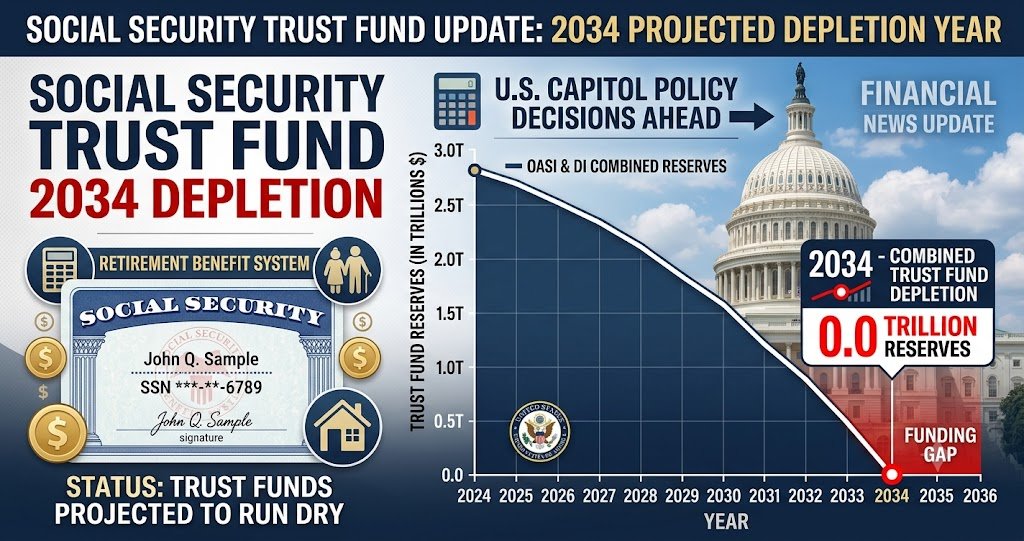
The Social Security trust fund remains under significant long-term financial pressure, according to the latest annual report from the Social Security Board of Trustees. The 2026 report projects that the combined Old-Age and Survivors Insurance (OASI) and Disability Insurance (DI) trust funds will have enough reserves to pay all scheduled benefits and administrative costs until 2034. At that point, the combined funds are projected to have reserves depleted, with incoming revenue sufficient to cover about 83% of scheduled benefits.
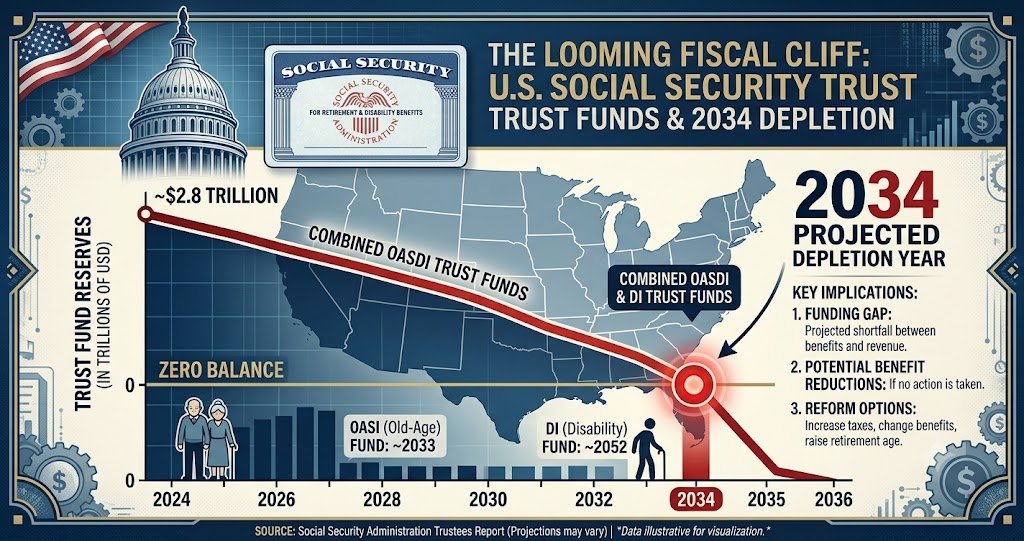
The new projection is broadly unchanged from last year’s combined-fund depletion date, but the report also highlights a more immediate concern for retirement benefits. The OASI Trust Fund, which finances retirement and survivor benefits, is projected to become depleted in the fourth quarter of 2032. At that point, continuing income would be enough to pay about 78% of scheduled OASI benefits under the Trustees’ intermediate assumptions.
For workers, retirees, employers and investors, the distinction is important. A depletion of trust fund reserves does not mean Social Security would suddenly stop collecting payroll taxes or paying benefits. Instead, the program would have less accumulated reserves available to supplement annual income from payroll taxes and other dedicated revenues.
Also Read: US Stock Market Forecast: Dow, Nasdaq & S&P 500 This Week
What the 2026 Social Security trust fund report says
The Social Security system operates through two legally separate trust funds: OASI and DI. OASI supports retirement and survivor benefits, while DI supports disability benefits. The funds are often discussed together as OASDI when evaluating Social Security’s overall financial position.
The 2026 Trustees Report says combined trust fund income, including interest, reached $1.45 trillion in 2025. Of that amount, approximately $1.32 trillion came from net payroll tax contributions, $58 billion from income taxation of benefits and $69 billion from interest. Combined expenditures were approximately $1.61 trillion during the year.
The difference between income and expenditures is one reason the reserve balance is declining. The combined trust funds ended 2025 with approximately $2.56 trillion in reserves, compared with about $2.72 trillion at the end of 2024.
That decline is significant because trust fund reserves act as a financial buffer when program costs exceed dedicated non-interest income.
When will the Social Security trust fund be depleted?
The answer depends on which trust fund is being discussed.
Under the intermediate assumptions in the 2026 Trustees Report:
- OASI Trust Fund: projected depletion in the fourth quarter of 2032.
- Combined OASI and DI funds: projected depletion in the third quarter of 2034.
- DI Trust Fund: projected to remain solvent throughout the 75-year projection period.
This means headlines stating that “Social Security will run out of money” can be misleading.
The trust fund reserves could be depleted, but Social Security would still have continuing revenue coming into the program. The central financial problem is that projected income would not be sufficient to pay 100% of scheduled benefits under current law.
The 2026 Trustees Report projects that, if the two funds were considered on a combined basis, approximately 83% of scheduled Social Security benefits would be payable when reserves are depleted in 2034. The percentage would then decline over time under the report’s intermediate assumptions.
Social Security trust fund balance by year
The reserve balance has changed substantially over the past several decades as the program’s income, benefit costs and investment earnings have evolved.
The latest official data show the combined OASI and DI reserves at approximately:
| Year | Combined Trust Fund Reserves |
| 2021 | $2.852 trillion |
| 2022 | $2.830 trillion |
| 2023 | $2.789 trillion |
| 2024 | $2.722 trillion |
| 2025 | $2.561 trillion |
These figures come from the Social Security Administration’s 2026 Trustees Report and represent reserves at the end of each calendar year.
The direction is more important than any single year’s figure. From the end of 2021 through the end of 2025, combined reserves declined by roughly $291 billion.
That trend reflects the widening gap between Social Security’s income and its costs. The Trustees project continued financial pressure in the coming years.
What is the Social Security trust fund interest rate?
The Social Security trust funds do not operate like a conventional personal savings account or investment portfolio.
By law, trust fund income that is not immediately required to pay program costs is invested in interest-bearing U.S. government securities. The trust funds currently hold special-issue Treasury securities that are available only to the trust funds.
In 2025, the combined trust fund reserves earned an effective annual interest rate of 2.6%, according to the 2026 Trustees Report. Interest income totaled approximately $69 billion during the year.
However, individual securities held by the trust funds can carry different interest rates depending on when they were issued and their maturity.
For example, the Treasury purchased special-issue bonds for the OASI and DI funds on June 30, 2025, carrying an interest rate of 4.500%. The rate was based on the average market yield on certain outstanding marketable U.S. obligations at the time.
Therefore, the phrase “Social Security trust fund interest rate” does not refer to one permanent rate applied to the entire fund.
How does a Social Security trust fund withdrawal work?
A Social Security trust fund withdrawal is different from an individual withdrawing money from a personal retirement account.
The trust funds are used to pay authorized Social Security benefits and certain administrative expenses. When the program’s current income is insufficient to cover all costs, Treasury securities held by the trust funds can be redeemed to provide the money needed for payments.
This is why the depletion date matters.
As reserves decline, there are fewer Treasury securities available to redeem. Once the reserves are exhausted, the program would rely on incoming revenue rather than accumulated reserves to finance benefits.
That does not automatically mean benefits would fall to zero. Instead, absent changes in law or additional financing, available income would determine how much of scheduled benefits could be paid.
When was the Social Security trust fund established?
The history of the trust fund goes back to the early years of the Social Security program.
The Social Security Act of 1935 created the original old-age reserve account. A formal Old-Age and Survivors Insurance Trust Fund was established through the Social Security Amendments of 1939. It became effective on January 1, 1940, replacing the earlier reserve account.
The Disability Insurance Trust Fund was established later, in 1956, when the disability insurance program was created. The two funds are still legally separate but are commonly analyzed together as OASDI.
That history matters because the current Social Security financing system is the result of decades of legislative changes, demographic shifts and economic conditions rather than a single recent development.
Why is the trust fund under pressure?
The core issue is the relationship between the number of people paying Social Security taxes and the number of people receiving benefits.
The Trustees’ projections account for factors including population growth, fertility, mortality, immigration, wage growth, employment and economic conditions. These assumptions influence both future payroll tax revenue and benefit costs.
As the U.S. population ages, a larger share of the population receives retirement benefits while the number of workers supporting the system through payroll taxes does not grow at the same pace.
The result is a structural financing gap.
The 2026 Trustees Report estimates the combined Social Security program has a 75-year actuarial deficit equal to 4.42% of taxable payroll under its intermediate assumptions.
This does not represent a single bill that must be paid immediately. It is a long-term measure of the gap between projected scheduled income and costs under current law.
What does the Social Security trust fund mean for workers and businesses?
For workers, the issue affects expectations about future retirement income.
People checking their My Social Security account may see estimates of future benefits based on their earnings history. Those estimates should not be confused with a personal trust fund balance.
Social Security is not structured as an individual investment account in which each worker owns a separate pool of money equal to the payroll taxes they have paid. Instead, payroll taxes and other program income flow through the Social Security financing system, while accumulated reserves are held in the trust funds.
For businesses, the issue is closely connected to payroll taxes, labor costs and potential future policy changes.
Any major effort to improve Social Security’s finances could involve some combination of higher revenues, changes to benefits, changes to eligibility rules or other legislative measures. The 2026 Trustees Report itself provides financial projections; it does not establish what policy Congress will ultimately choose.
What the 2034 projection means for financial planning
The 2034 date should not be interpreted as a deadline at which every Social Security benefit disappears.
Instead, it is a warning about the point at which accumulated reserves are projected to be exhausted under current law and the Trustees’ assumptions.
For households, the development reinforces the importance of considering Social Security as one component of retirement planning rather than assuming it will necessarily cover all retirement expenses.
For financial professionals and business leaders, the issue also matters because changes to Social Security taxes or benefits could affect household disposable income, labor costs, retirement behavior and federal fiscal policy.
For investors, Social Security’s financial outlook is also part of the broader debate over U.S. fiscal policy, although the trust funds themselves are invested in special-issue Treasury securities rather than stocks or corporate bonds.
What happens next?
The key question is no longer simply whether Social Security faces a long-term financing problem. The 2026 Trustees Report confirms that the program does.
The more important question is what policymakers will do before reserves are exhausted.
Congress could make changes to payroll taxes, taxable earnings, benefits, eligibility or other aspects of the program. Different policy combinations would distribute costs and benefits differently among workers, retirees, employers and future generations.
Until legislation changes the current system, the Trustees’ projections remain the clearest official benchmark for understanding the program’s financial position.
For now, the central figures are straightforward: the combined Social Security trust funds are projected to remain able to pay all scheduled benefits through 2034, while the OASI retirement and survivor fund faces depletion in 2032. After reserve depletion, continuing program income is projected to cover only part of scheduled benefits unless policymakers act.
Also Read: Why UK Insurers Won’t Cover Chinese EVs Causes Costs & Solutions
Conclusion
The latest Social Security trust fund projections provide a clearer picture of the program’s financial challenge. The combined funds are projected to maintain reserves through 2034, while the retirement-focused OASI fund faces depletion in 2032. At neither date would Social Security payments automatically fall to zero.
The immediate concern is the gap between scheduled benefits and the revenue expected to be available after reserves are exhausted. For workers, retirees and businesses, the issue is therefore less about a single “Social Security collapse” date and more about how policymakers respond to a persistent long-term financing gap.
The 2026 Trustees Report gives policymakers more than a decade before the combined reserves are projected to run out, but the financial gap is already affecting the program’s annual cash flow. Any changes made before depletion could influence taxes, benefits and retirement planning for millions of Americans.
For business and finance readers, the most important takeaway is simple: Social Security remains operational today, but its long-term financing requires policy action if scheduled benefits are to continue at their current projected levels.
FAQs
Is the Social Security trust fund running out of money?
The trust fund reserves are projected to be depleted in 2034 on a combined OASI and DI basis under the 2026 Trustees Report’s intermediate assumptions. However, Social Security would continue receiving payroll taxes and other income after reserves are depleted.
When will the Social Security trust fund be depleted?
The combined OASI and DI trust funds are projected to be depleted in the third quarter of 2034. The OASI Trust Fund alone is projected to be depleted in the fourth quarter of 2032.
What happens when the Social Security trust fund is depleted?
Depletion means the accumulated reserves would no longer be available to supplement program income. Under current projections, incoming revenue would still support Social Security benefits, but it would not be enough to pay 100% of scheduled benefits.
Can I check my Social Security trust fund balance?
There is no individual Social Security trust fund balance assigned to each worker. People can use their My Social Security account to review their earnings record and estimated future benefits, but that is different from owning a personal trust fund account.
What is the Social Security trust fund interest rate?
The combined trust funds earned an effective annual interest rate of 2.6% in 2025. Individual Treasury securities held by the funds can have different interest rates.
When was the Social Security trust fund established?
The formal OASI Trust Fund was established under the Social Security Amendments of 1939 and became effective January 1, 1940. The Disability Insurance Trust Fund was established in 1956.






1 thought on “Social Security Trust Fund: 2034 Depletion Date Explained”