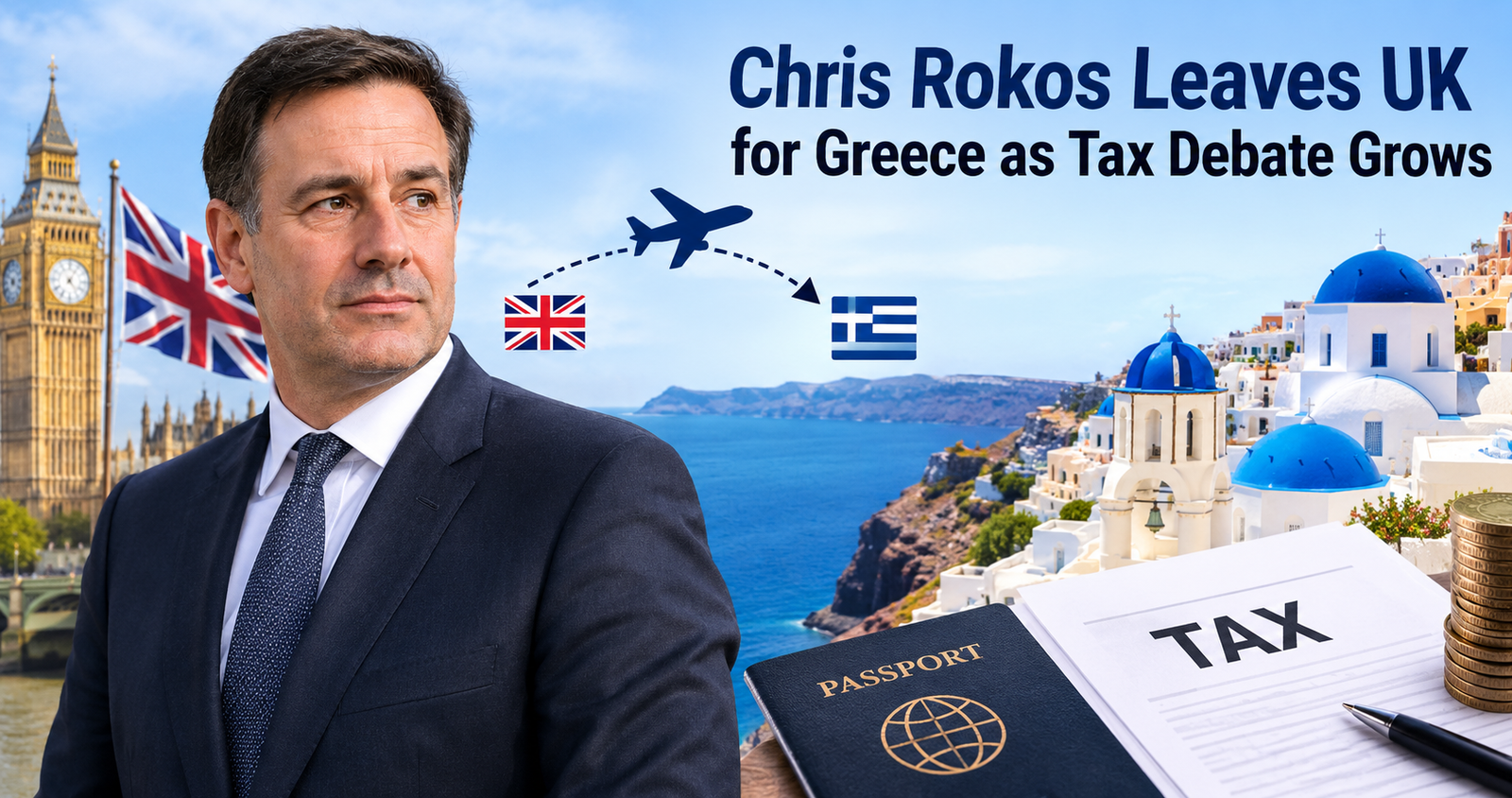
Hedge fund founder Chris Rokos is preparing to leave the UK and switch his tax residency to Greece, according to current reports, putting one of Britain’s most prominent finance figures at the center of a renewed debate over taxation and the country’s ability to retain wealthy investors.
Rokos, founder and chief investment officer of Rokos Capital Management, is expected to establish a presence in Athens as part of the move, according to people familiar with the arrangements cited by Bloomberg. The firm manages about $22 billion, although a representative declined to comment on the reported relocation.
The reported move comes after major changes to Britain’s tax treatment of wealthy international residents and amid speculation about further tax measures. It also adds another high-profile name to a wider discussion about whether Britain’s tax policies could encourage some wealthy residents to relocate.
Also Read: Taking Magnesium? This Is the Most Important Thing to Remember
Chris Rokos leaves UK and plans Greece residency
According to Bloomberg, Rokos is switching his residency to Greece and plans to open an Athens office connected with his move. The report cited people familiar with the arrangement who requested anonymity because the details are private.
The Financial Times separately reported that Rokos is relocating his residency from Britain to Greece as concerns about potential future tax increases grow.
The distinction between personal tax residency and the location of a financial company is important.
Rokos Capital Management remains a major international investment business with operations beyond Britain. Public company information shows the firm has a global footprint, including London, New York, Singapore and Abu Dhabi.
Therefore, the reported personal relocation should not automatically be interpreted as the hedge fund leaving London or moving its entire business out of Britain.
Why is Chris Rokos considering Greece?
The reported decision comes against a changing UK tax environment.
From 6 April 2025, the UK abolished the previous remittance-basis system for non-UK domiciled individuals and moved to a residence-based framework. HMRC says UK residents are generally taxed on the arising basis on worldwide income and gains, subject to the new foreign income and gains regime for qualifying new residents.
The reform was one of the government’s major changes affecting internationally mobile wealthy individuals.
Under the previous rules, some UK residents who were non-UK domiciled could use the remittance basis, meaning certain foreign income and gains could receive different UK tax treatment if they were not brought into the country.
The new system significantly changed that framework.
For wealthy individuals whose income and investments are spread across multiple countries, tax residency can therefore become an important part of long-term financial planning.
Greece offers an alternative tax environment
Greece has sought to attract wealthy international residents with tax incentives.
The Financial Times reported that Greece offers certain foreign investors a flat annual tax arrangement covering foreign income, subject to eligibility requirements, including a minimum investment requirement.
That creates a potential incentive for internationally mobile investors to compare tax systems when deciding where to establish their primary residence.
However, moving tax residency is not simply a matter of changing one’s address.
Tax residency is determined under applicable rules, and wealthy individuals with international business interests can face complex questions involving residence, income, capital gains, investments, property and business activity.
Who is Chris Rokos?
Chris Rokos is the founder and chief investment officer of Rokos Capital Management.
Before establishing RCM, he was one of the founding partners of Brevan Howard and spent years working in macro trading. Chatham House describes him as having around three decades of experience in financial services and identifies him as founder and CIO of Rokos Capital Management.
Rokos launched his own firm in 2015 after leaving Brevan Howard. The business subsequently developed into a major global macro hedge fund.
Its investment strategies cover areas including interest rates, foreign exchange, equities, credit, emerging markets and commodities.
Rokos remains closely connected to Britain
A move to Greece does not mean Rokos has abandoned his British connections.
He has significant philanthropic links to UK institutions. The Financial Times reported that he has made major donations, including a £190 million contribution to Cambridge University, while he has also invested in historic property in Britain.
His reported relocation therefore illustrates a more complicated issue than simply whether a wealthy individual “leaves Britain.”
A person can change tax residency while retaining investments, businesses, property, charitable interests and professional relationships in the UK.
What does the move mean for Rokos Capital Management?
At this stage, the reported change should not be confused with a corporate departure from the UK.
Rokos Capital Management continues to have a substantial London presence, and the company has been expanding internationally.
In May 2026, Bloomberg reported that RCM had received regulatory approval to operate in Abu Dhabi and was moving forward with an office there.
The firm also operates internationally through offices including New York and Singapore.
That global structure makes it possible for the business to maintain operations across multiple financial centers even if its founder changes personal tax residency.
Why investors are watching the story
The significance of Chris Rokos leaves UK extends beyond one individual because Britain is competing with other international financial centers for capital and talent.
London remains one of the world’s major financial hubs, with deep capital markets, professional services, legal infrastructure and access to international investors.
At the same time, internationally mobile investors can compare jurisdictions more easily than in the past.
Tax policy is one factor in that decision, but it is not the only one.
Political stability, access to financial markets, regulation, quality of life, family considerations and business infrastructure can also influence where wealthy individuals choose to live.
Is Rokos definitely leaving Britain?
Current reporting says Rokos is set to leave the UK and switch his residency to Greece, but the precise details of the arrangement are private.
Bloomberg reported that a representative for Rokos Capital Management declined to comment.
That distinction matters. Reports about a planned change in tax residency should not be presented as evidence that every aspect of Rokos’s business or personal affairs has already moved.
What it means for the UK’s tax debate
The reported relocation is likely to add fuel to an existing political argument.
Supporters of tougher taxation of wealthy residents argue that individuals with substantial financial resources should contribute fairly to public finances. Critics argue that excessively aggressive tax policies can make it harder for countries to retain high-value taxpayers and attract international capital.
Rokos’s reported move provides a prominent example for both sides of that debate, but one person’s decision cannot by itself establish the economic effect of UK tax policy.
The broader question is whether the additional tax revenue generated by reforms outweighs any potential loss of residents, investment, business activity or future tax receipts.

The wider wealth migration question
Rokos is not the only wealthy individual reported to have considered or completed a move away from Britain.
The Financial Times and other reports have pointed to departures or potential departures involving other wealthy business figures, including Lakshmi Mittal and Nassef Sawiris.
The UK’s abolition of the non-dom system has become a major part of this debate.
HMRC confirms that from April 2025 the previous remittance basis was abolished, while a new four-year Foreign Income and Gains regime is available to qualifying new UK residents who meet the relevant conditions.
The new framework therefore does not simply eliminate every tax incentive for internationally mobile people. Instead, it creates a different set of rules based largely on residence and length of residence.
Also Read: Social Security Trust Fund: 2034 Depletion Date Explained
Conclusion
The reported decision by Chris Rokos to leave the UK for Greece puts the billionaire hedge fund founder at the center of a much wider debate about Britain’s tax system and its appeal to internationally mobile wealth.
Rokos’s move is significant because of his position in global finance and the size of Rokos Capital Management. But it should not be interpreted as evidence that his entire hedge fund business is leaving Britain.
The more important question for policymakers is whether changes to taxation can raise additional revenue while maintaining the UK’s ability to attract and retain entrepreneurs, investors and financial professionals.
For investors and businesses watching the UK, the Rokos story is another indication that international tax residency and cross-border financial planning remain increasingly important considerations in global finance.
FAQs
Is Chris Rokos leaving the UK?
Current reports say Chris Rokos is preparing to leave the UK and change his tax residency to Greece. Bloomberg reported that he also plans to establish an Athens office.
Why is Chris Rokos moving to Greece?
Reports have linked the move to concerns about Britain’s changing tax environment and the tax advantages available in Greece for qualifying wealthy international residents.
Is Rokos Capital Management leaving London?
There is no evidence that the entire company is leaving London. RCM continues to have a significant UK presence and operates internationally.
Who is Chris Rokos?
Chris Rokos is the founder and CIO of Rokos Capital Management and a former founding partner of Brevan Howard.
Did the UK change its non-dom tax rules?
Yes. From 6 April 2025, the previous remittance-basis system was abolished and replaced by a residence-based framework, including a four-year Foreign Income and Gains regime for qualifying new residents.
Could other wealthy people leave the UK?
Some wealthy individuals have already been reported as leaving or considering moves, but the scale and long-term economic impact of wealth migration remain matters of ongoing debate.