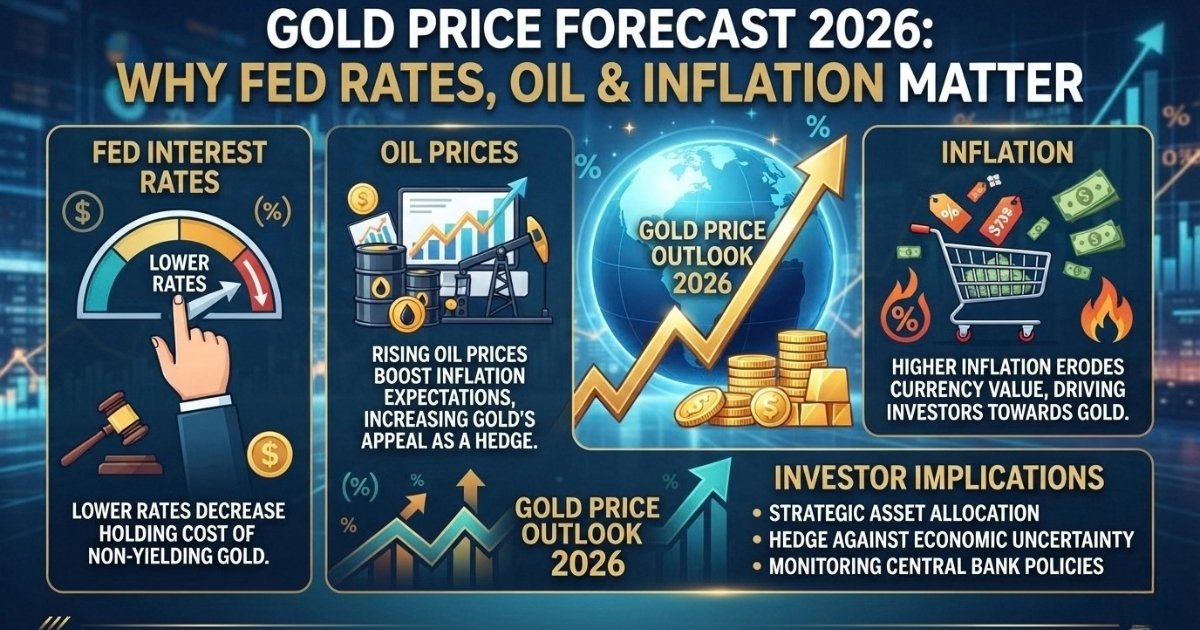
Gold Price Forecast 2026: Why Fed Rates, Oil and Inflation Matter for Investors
Gold has become one of the most closely watched assets in global financial markets in 2026. Investors, businesses, central banks and ordinary savers are all watching the same question: where could gold prices go next, and what economic forces could move them?
The answer is more complicated than simply looking at supply and demand. Interest rates, inflation, oil prices, the U.S. dollar, geopolitical uncertainty and central-bank activity can all influence the precious-metal market.
As of September 22, 2026, spot gold was around $4,295 per ounce after falling about 1.1% during the trading session, according to Reuters. The decline came as oil prices moved higher and Federal Reserve policymakers signalled that interest rates could remain elevated for longer.
That combination makes the current market particularly interesting for anyone researching the Gold Price Forecast 2026. Instead of looking for one guaranteed number, investors can understand the major forces that could push gold higher, lower or keep it volatile.
This guide examines those forces across the USA, UK, Canada and Australia.
Also Read: Petco Loyalty Program Financial Losses Hit Millions After Rewards Redemptions Exceed Expectations
Gold Price Forecast 2026: What Is Moving the Market Right Now?
The gold market is currently being pulled in different directions.
On one side, geopolitical uncertainty, elevated energy prices and inflation concerns can increase demand for assets traditionally viewed as stores of value. On the other, higher interest rates and stronger real yields can make interest-bearing assets relatively more attractive.
The Federal Reserve raised its federal funds target range by 25 basis points on September 16, taking it to 3.75%–4%. The Fed said inflation remained elevated and that the policy action was intended to support a return toward its 2% inflation goal.
Reuters reported on September 22 that hawkish comments from Fed officials and higher oil prices were weighing on gold.
This creates an important tension for the market:
Higher rates can pressure gold, while inflation and geopolitical risks can support demand for it.
That is why investors should monitor the underlying economic variables instead of treating every daily gold-price move as a long-term trend.
The Fed, Dollar and Treasury Yields
Gold is priced internationally in U.S. dollars. Therefore, changes in the dollar can influence how expensive gold becomes for international buyers.
Treasury yields also matter because gold does not generate interest or dividends. When inflation-adjusted yields become more attractive, the opportunity cost of holding gold can increase.
This relationship is not mechanical, however. Gold can sometimes rise even while yields are high if investors are concerned about geopolitical risk, financial instability or persistent inflation.
Oil Prices Are an Important New Variable
Oil deserves special attention in the second half of 2026.
Higher crude prices can feed into transportation, manufacturing and household energy costs. If those increases keep inflation elevated, central banks may face more pressure to maintain restrictive monetary policy.
Reuters has recently linked oil-price movements, inflation concerns and changing expectations for interest rates with gold-price volatility.
This means oil is not simply another commodity to watch. It can influence the inflation-and-interest-rate chain that eventually affects gold.
Gold Price Forecast 2026 for the USA
The United States remains the most important market to watch because Federal Reserve policy has a major influence on global financial conditions.
The September 16 Fed decision is particularly relevant. The central bank increased its target range to 3.75%–4% while stating that inflation remained elevated.
For investors researching the gold price forecast USA 2026, four variables deserve close attention:
- Federal Reserve interest-rate decisions
- U.S. Treasury yields
- The U.S. dollar
- Inflation expectations
Why Fed Rate Hikes Can Pressure Gold
Suppose an investor can earn a relatively attractive return from short-term government securities. Holding an asset that does not pay interest becomes comparatively less attractive.
That does not mean gold must fall whenever the Fed raises rates.
The September 2026 market illustrates the complexity. Gold has remained at historically elevated levels even as monetary policy has tightened, while geopolitical and inflation concerns have continued to affect demand.
What U.S. Investors Should Watch Next
Rather than focusing only on the headline gold price, investors can track:
Fed statements → Treasury yields → dollar strength → inflation data → gold reaction
This sequence provides a more useful framework for understanding daily movements.
For financial readers of innovativeblogtech, this also creates an opportunity to connect market news with practical financial education rather than simply publishing a daily gold-price number.
Gold Price Forecast 2026 for the UK
The UK presents a different monetary-policy environment.
The Bank of England maintained Bank Rate at 3.75% in September 2026 by a 6–3 vote. Three members preferred a 25-basis-point increase to 4%. The Bank also said UK CPI inflation had increased to 3.1% in August and warned that energy-price developments could create additional inflation pressure.
For readers researching the gold price forecast UK 2026, the key variables include:
- Bank of England interest rates
- UK inflation
- GBP/USD exchange rates
- Energy prices
- Global gold prices in U.S. dollars
Why GBP Matters to UK Gold Buyers
A UK investor does not experience the gold market exactly as a U.S. investor does.
International gold is generally quoted in dollars. Therefore, movements in sterling can change the local GBP price even when the dollar gold price changes only modestly.
For example, if gold remains stable in USD but sterling weakens against the dollar, UK buyers could see a different price movement in GBP.
The Bank of England has also highlighted the connection between the Middle East conflict, higher energy prices and UK inflation.
That makes the interaction between gold, sterling and UK interest rates particularly important during the remainder of 2026.
Gold Price Forecast 2026 for Canada
Canada adds another important dimension because of its relationship with energy markets, the Canadian dollar and the U.S. economy.
The Bank of Canada kept its policy rate at 2.25% on September 2, 2026, while noting that high energy prices and new U.S. tariffs and Canadian counter-measures were contributing to economic uncertainty.
For readers following the gold price forecast Canada 2026, several indicators deserve attention:
- Bank of Canada policy
- Canadian dollar movements
- Crude oil prices
- Canadian inflation
- U.S. economic conditions
Oil Creates a Unique Canada Connection
Canada is a major energy producer, so oil prices can have important implications for the Canadian economy and currency.
That does not mean higher oil automatically produces higher gold prices in Canadian dollars. Instead, investors need to watch the interaction between crude prices, CAD/USD movements, inflation and central-bank policy.
The Bank of Canada has specifically noted that elevated energy prices are contributing to inflation pressures.
This makes Canada an interesting example of why a global commodity cannot be analysed through a single variable.
Gold Price Forecast 2026 for Australia
Australia’s gold market is influenced by global bullion prices, the Australian dollar, domestic monetary policy and commodity-market conditions.
The Reserve Bank of Australia left its cash-rate target at 4.35% in August 2026, while noting that inflation remained too high and that oil and related commodity prices were still above levels seen before the Middle East conflict.
For anyone tracking the gold price forecast Australia 2026, important factors include:
- RBA interest rates
- Australian inflation
- AUD/USD exchange rates
- Global commodity demand
- Chinese economic conditions
Why the Australian Dollar Matters
Australian investors can experience a different gold-price trend from investors in the United States.
If the Australian dollar weakens against the U.S. dollar, internationally priced gold can become more expensive in AUD terms even if the USD gold price is relatively stable.
This is why an Australian investor should look at both the international gold chart and the local AUD price.
The Australian economy’s broader exposure to commodities also makes developments in China and global industrial demand important variables to monitor.
Gold and Interest Rates: The Relationship Investors Need to Understand
The relationship between gold and interest rates is often simplified into one sentence: rates rise, gold falls.
Real markets are more complicated.
The important concept is the real interest rate—the return available after considering inflation.
If nominal interest rates rise but inflation rises even faster, real returns may not improve significantly. In that environment, gold can continue attracting attention.
Conversely, if inflation falls while interest rates remain relatively high, real yields can become more attractive and potentially reduce demand for non-yielding assets.
This is one reason investors should avoid interpreting one Fed decision in isolation.
Gold Price and Inflation: Does Higher Inflation Always Mean Higher Gold?
The relationship between gold price and inflation is another area where headlines can oversimplify the market.
Gold is often viewed as an inflation hedge, but its performance depends on what is causing inflation and how central banks respond.
Consider two situations.
Scenario A: Inflation rises because of stronger demand, while the central bank responds aggressively with higher interest rates.
Scenario B: Inflation rises because energy prices jump due to a supply shock, while economic growth weakens.
The market reaction can be very different.
The September 2026 environment contains elements of the second situation, with energy-price volatility affecting inflation expectations and monetary-policy discussions in several economies. The Bank of England and Bank of Canada have both highlighted energy-price risks in their recent policy communications.
Therefore, investors should ask not only “Is inflation rising?” but also “Why is inflation rising, and what are central banks doing about it?”
Gold Forecast After Fed Rate Hike 2026: What Could Happen Next?
The phrase gold forecast after Fed rate hike 2026 has become especially relevant following the September 16 decision.
There are several possible market paths.
Scenario 1: Rates Stay Higher for Longer
If inflation remains persistent and policymakers continue favouring restrictive monetary policy, Treasury yields and the dollar could remain important headwinds for gold.
Scenario 2: Inflation Starts Cooling
If inflation gradually moves lower and markets begin expecting easier monetary policy, pressure from real yields could decrease.
Scenario 3: Geopolitical or Energy Risks Intensify
A renewed energy shock or geopolitical escalation could increase demand for defensive assets even if interest rates remain elevated.
The important point is that these scenarios can change quickly. A forecast should therefore be treated as a framework rather than a guaranteed price target.
Oil Prices and Gold Price 2026: Why Energy Matters
The relationship between oil prices and gold price 2026 deserves more attention because energy costs can affect several parts of the financial system simultaneously.
Higher oil prices can increase:
- Transportation costs
- Manufacturing expenses
- Household energy bills
- Inflation expectations
- Central-bank policy pressure
Reuters reported on September 22 that rising oil prices and hawkish Fed signals were weighing on gold prices.
But the relationship can change depending on the reason oil prices rise.
If oil rises because global economic demand is strong, the market interpretation can differ from an oil surge caused by geopolitical disruption.
That distinction is important for investors and business owners assessing costs, currencies and financial-market risks.
Gold Price Outlook 2026: What Investors Should Monitor
The gold price outlook 2026 should be viewed through a dashboard of indicators rather than one chart.
1. Federal Reserve Policy
Watch every Fed meeting, inflation report and policy statement.
2. U.S. Treasury Yields
Higher real yields can influence the opportunity cost of holding gold.
3. U.S. Dollar
Dollar strength can affect international gold pricing.
4. Oil
Oil can influence inflation and therefore central-bank decisions.
5. Central-Bank Gold Demand
LBMA’s 2026 analyst survey identifies U.S. monetary policy, central-bank activity and geopolitics among the major factors influencing gold. Its published analyst forecasts also show a wide range of expectations rather than one universally accepted price target.
6. Geopolitical Developments
Unexpected geopolitical developments can quickly change investor demand for perceived safe-haven assets.
For business readers, these indicators can also affect currency costs, borrowing conditions, commodity expenses and portfolio risk.
Gold Price Prediction 2026: Why One Number Is Not Enough
Searching for a gold price prediction 2026 can produce dramatically different numbers across banks, analysts and financial websites.
That variation is itself useful information.
LBMA’s published analyst survey shows substantial differences between individual forecasts and their underlying assumptions. For example, analysts cited different expectations based on monetary policy, central-bank buying, geopolitical risks and economic growth.
Instead of asking for one exact number, a better research question is:
What assumptions would need to change for gold to move higher or lower?
That approach makes a forecast more useful because it can be updated when new inflation data, rate decisions or geopolitical developments arrive.
What Gold Investment 2026 Means for Different Investors
The phrase gold investment 2026 can refer to very different strategies.
A long-term investor may be interested in diversification. A trader may focus on short-term volatility. A business owner may simply want to understand how commodity prices affect currencies and financing conditions.
Gold can be accessed through different instruments, including physical bullion, exchange-traded products and other market instruments, depending on the investor’s jurisdiction.
Each has different costs, liquidity characteristics, taxation and risks.
Therefore, investors should consider factors such as:
- Investment objective
- Time horizon
- Transaction costs
- Storage requirements
- Liquidity
- Currency exposure
- Tax treatment
- Overall portfolio allocation
For readers using financial information from innovativeblogtech, the important distinction is between understanding a market and assuming that a particular asset will deliver a specific return.
A Simple Example: How the Same Gold Move Can Affect Four Countries Differently
Imagine international gold rises 5% in U.S. dollars.
A U.S. investor may see a movement relatively close to that headline percentage before fees and taxes.
A UK investor also has to consider the pound-dollar exchange rate.
A Canadian investor needs to consider CAD/USD movements and the domestic energy environment.
An Australian investor must consider AUD/USD movements alongside global commodity conditions.
So, one global gold chart does not tell the entire story.
This is why a four-country framework can make gold-market coverage more useful for international readers.
What Should Investors Watch Before the End of 2026?
The remainder of 2026 could be shaped by several interconnected questions:
Will inflation continue to stay above central-bank targets?
Will the Federal Reserve maintain restrictive policy?
Will oil prices remain elevated?
Will the U.S. dollar strengthen or weaken?
Will geopolitical uncertainty increase or fade?
Will central banks continue accumulating gold?
There is no single answer to these questions today.
Instead, investors can monitor official economic releases and central-bank decisions and then reassess their assumptions as new information arrives.
For a financial-information website such as innovativeblogtech, this approach also creates opportunities to update an article rather than publishing a completely new prediction every time the gold price moves.
Conclusion: Gold in 2026 Is a Macro Story, Not Just a Commodity Story
The gold market in 2026 is being influenced by a combination of monetary policy, inflation, oil prices, currency movements and geopolitical developments.
The current market provides a clear example. Gold fell on September 22 as higher oil prices and hawkish Federal Reserve signals increased concerns about a higher-for-longer interest-rate environment.
At the same time, the UK is dealing with elevated inflation and energy-price uncertainty, Canada is balancing inflation and trade risks, and Australia continues to monitor inflation and commodity-price pressures.
For that reason, the Gold Price Forecast 2026 should not be treated as a single guaranteed number. The more useful approach is to follow the economic drivers behind the price.
Investors and business owners who understand the relationship between rates, inflation, oil, currencies and gold will be better positioned to interpret market headlines as new data arrives.
Financial disclaimer: This article is for educational and informational purposes only. It is not investment, financial, tax or trading advice. Gold prices can be volatile, and past performance does not guarantee future results.
Also Read: Petco Loyalty Program Financial Losses Hit Millions After Rewards Redemptions Exceed Expectations More Details on Watch Youtube
Frequently Asked Questions
1. What is driving gold prices in September 2026?
Gold prices are being influenced by Federal Reserve policy, U.S. Treasury yields, the dollar, oil prices, inflation expectations and geopolitical developments. On September 22, Reuters reported that gold declined as oil prices increased and Fed officials signalled that rates could remain higher for longer.
2. How do Fed rate hikes affect gold prices?
Higher interest rates can increase the opportunity cost of holding gold because gold does not pay interest. However, the relationship is not automatic. Inflation, real yields, the dollar and geopolitical risks can all influence the market at the same time.
3. Is gold a good hedge against inflation in 2026?
Gold is often used as a portfolio diversification or inflation-hedging asset, but it does not automatically rise whenever inflation increases. The market reaction depends on the type of inflation and how central banks respond to it.
4. Why can gold prices differ between the USA, UK, Canada and Australia?
International gold is commonly quoted in U.S. dollars, while investors in other countries purchase gold in their local currencies. Exchange-rate movements can therefore cause the local price to behave differently from the USD price.
5. What should investors watch when analysing gold prices?
Key indicators include Federal Reserve policy, Treasury yields, inflation data, the U.S. dollar, oil prices, central-bank gold demand and geopolitical developments. Following these indicators together can provide more context than watching the daily gold price alone.