When Should You Take a Personal Loan? 7 Smart Reasons
Have you ever faced a $5,000 car repair, a sudden medical bill, or several credit-card balances that seem impossible to pay down? When savings aren’t enough, borrowing may enter the conversation. But taking on debt is a decision that deserves more thought than simply asking whether you can qualify.
So, when should you take a personal loan?
The answer depends on what you need the money for, how much the loan will actually cost, what alternatives are available, and whether the monthly payment fits comfortably into your budget. A personal loan can provide a structured way to finance a large expense or consolidate certain debts, but it can also become expensive if the terms are unfavorable.
This guide explains seven situations in which a personal loan may be worth considering, when borrowing may be inappropriate, how to compare a personal loan with a credit card, and practical steps you can take before applying. The goal isn’t to encourage borrowing. It’s to help you make a more informed decision.
What Is a Personal Loan?
A personal loan is generally an installment loan. You receive a lump sum and repay it through scheduled payments over a defined period.
The Consumer Financial Protection Bureau explains that personal installment loans can be used for purposes including large purchases, unexpected expenses, and debt consolidation. Lenders may consider factors such as your credit history, income, existing debts, loan amount, and repayment term when determining your terms.
Many personal loans are unsecured, meaning you generally don’t pledge your home or vehicle as collateral.
Before accepting one, look at:
- APR
- Interest rate
- Monthly payment
- Loan term
- Origination fee
- Late-payment fees
- Total repayment amount
APR deserves special attention because it incorporates the interest rate and certain loan fees, making it useful for comparing borrowing costs.
Think of a personal loan like putting a large expense into a financial container with a fixed lid. You know how much you’re borrowing and usually know when the container will be empty. A credit card, by comparison, can remain open and reusable, which can make debt easier to extend.
When Should You Take a Personal Loan?
There isn’t one universal answer to when should you take a personal loan.
A personal loan may make sense when you have a specific financial need, understand the total borrowing cost, and can comfortably handle the repayment.
The Federal Reserve’s latest available consumer-credit data shows why borrowing costs deserve attention. In July 2026, the average finance rate reported for 24-month personal loans at commercial banks was 11.86%, while the average interest rate on credit-card plans across all accounts was 20.94%. These are broad market measures, not quotes for an individual borrower, and actual offers can vary significantly.
That difference illustrates why comparing financing options matters.
Here are seven situations to consider.
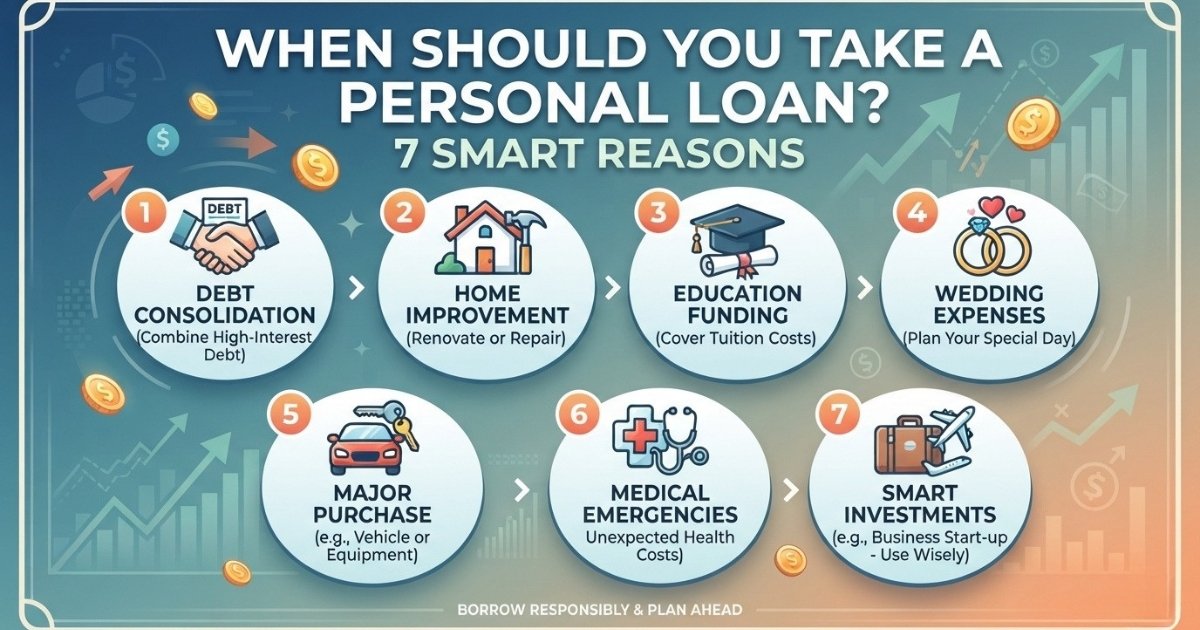
7 Smart Reasons to Consider a Personal Loan
1. You Need to Consolidate High-Interest Debt
Debt consolidation is one of the most discussed good reasons to take a personal loan.
Imagine having four credit-card balances with different payment dates and interest rates. A personal loan could potentially combine those balances into one scheduled payment.
But there is an important condition.
The new loan should actually improve your financial position.
Compare:
- Existing APRs
- New loan APR
- Origination fee
- Monthly payment
- Repayment period
- Total interest
- Total amount repaid
A lower monthly payment alone isn’t enough.
For example, extending repayment from three years to five years could reduce the monthly payment while keeping you in debt longer.
The Federal Reserve’s current data also illustrates why consumers should compare borrowing costs rather than assume every form of credit costs the same.
2. You Have a Major Emergency Expense
A personal loan for emergency expenses can sometimes be considered when your savings aren’t enough.
Possible situations include:
- Major vehicle repairs
- Essential home repairs
- Unexpected necessary expenses
- Certain unavoidable family expenses
Suppose your vehicle requires a $5,000 repair and your emergency fund contains $2,000.
You could compare several options:
Option 1: Use the $2,000 savings and finance the remaining amount.
Option 2: Use another available financing option.
Option 3: Compare personal-loan offers.
The important point is that an emergency doesn’t automatically make a personal loan affordable.
Check the APR, fees and payment before committing.
3. The Loan Costs Less Than Your Alternatives
One of the clearest answers to when is a personal loan a good idea is when its total cost is reasonable compared with the alternatives available to you.
Don’t compare only the advertised interest rate.
Compare APR.
The CFPB explains that APR combines the interest rate with certain additional fees associated with borrowing.
For example, compare:
| Financing option | What to examine |
|---|---|
| Personal loan | APR, fees, term and total repayment |
| Credit card | APR, balance-transfer fees and payoff period |
| 0% promotional offer | Promotional period and post-promotion APR |
| Savings | Opportunity cost and emergency-fund impact |
| Other financing | Rate, fees and repayment conditions |
The lowest monthly payment isn’t necessarily the lowest total cost.
4. You Need to Finance an Essential Large Expense
Another possible reason to borrow is a large expense that cannot reasonably be postponed.
Examples could include:
- Essential home repairs
- Necessary vehicle expenses
- Certain major personal expenses
- A significant one-time expense
The distinction between a need and a want matters.
Borrowing $8,000 for an essential roof repair is financially different from borrowing $8,000 for a luxury vacation.
Neither situation should automatically result in a loan. But the purpose of the borrowing should be part of the decision.
Ask:
“Would I still need this expense if I couldn’t borrow the money?”
If the answer is no, waiting and saving may deserve consideration.
5. You Have a Clear Repayment Plan
A major factor in when to use a personal loan is whether you can see a realistic path to repayment.
Before applying, calculate your expected monthly payment and compare it with your current budget.
Ask:
- Can I make the payment every month?
- Will I still have money for essential expenses?
- Can I continue saving?
- What happens if my income temporarily falls?
- How long will I remain in debt?
A predictable income can make budgeting easier, but income alone isn’t enough.
Your existing obligations matter too.
6. You Qualify for Reasonable Loan Terms
Loan offers aren’t identical.
Lenders may evaluate credit history, credit score, income, debt and other factors when deciding eligibility and pricing.
That’s why you shouldn’t assume the rate shown in an advertisement is the rate you’ll receive.
Before accepting an offer, check:
- APR
- Loan amount
- Monthly payment
- Loan term
- Origination fee
- Late fees
- Total repayment
- Any additional conditions
The CFPB notes that personal installment loans can carry fees such as origination and late-payment fees, so borrowers should review the loan disclosures carefully.
7. The Loan Solves a Specific Financial Problem
The final reason is simple: the loan should have a clear purpose.
Ask yourself three questions:
How much do I need?
Why do I need it?
How will I repay it?
Compare:
“I need $7,000 for an essential repair, and I have compared the available financing options.”
with:
“The lender approved me for $15,000, so I might as well take it.”
The first approach starts with a financial need.
The second starts with the availability of credit.
That distinction can make a major difference.
When Should You Avoid a Personal Loan?
Understanding when should you avoid a personal loan is just as important as understanding when to consider one.
You don’t have a repayment plan
If you don’t know how you’ll make the payments, adding debt may increase financial pressure.
The APR is too high
A loan may not be useful if the borrowing cost is substantially higher than your alternatives.
You’re borrowing for unnecessary spending
A vacation, luxury purchase or impulse purchase can become much more expensive when financed over several years.
You’re repeatedly borrowing to pay existing debt
A consolidation loan doesn’t automatically solve the behavior or budget problem that created the debt.
Your current budget is already stretched
Consider rent or mortgage payments, utilities, food, transportation, insurance, existing loans and savings before adding another monthly obligation.
You haven’t compared alternatives
Don’t assume a personal loan is automatically cheaper.
Compare the actual numbers.
Personal Loan vs. Credit Card
The personal loan vs credit card decision depends on your specific circumstances and the terms available to you.
| Factor | Personal Loan | Credit Card |
|---|---|---|
| Structure | Installment | Revolving |
| Funding | Usually lump sum | Reusable credit line |
| Repayment | Scheduled payments | Minimum payment plus additional payments |
| APR | Often fixed, depending on loan | Often variable |
| Term | Defined | Open-ended |
| Common use | Specific large expense | Ongoing purchases |
| Fees | May include origination fee | May include annual, balance-transfer or other fees |
The CFPB describes APR as a standard way to compare the cost of credit products.
For a specific one-time expense, a fixed installment structure may provide clearer repayment boundaries.
For flexible ongoing spending, revolving credit works differently.
Neither should automatically be considered superior.
Compare the actual offer.
Tools and Platforms to Compare Loans
Before deciding when should you take a personal loan, use tools that help you understand the numbers.
1. Personal loan calculators
A loan calculator can estimate:
- Monthly payment
- Total interest
- Total repayment
- Effect of changing the term
Try different loan amounts and repayment periods.
2. Prequalification tools
Some lenders allow potential borrowers to check possible offers before completing a full application.
However, read the lender’s explanation of whether the inquiry is soft or hard and what information is required.
3. Budgeting spreadsheets
A simple spreadsheet can show:
Monthly income − essential expenses − existing debt payments − new loan payment = remaining cash flow
That final number matters.
4. Official lender disclosures
Don’t rely only on advertisements.
Read the actual loan terms.
The CFPB recommends reviewing loan disclosures and comparing offers because fees can add to the overall cost.
Proven Strategies Before Borrowing
Here are three practical strategies you can use before applying.
Strategy 1: Compare total cost, not monthly payment
A $300 monthly payment can sound comfortable.
But ask:
How many months?
What APR?
What fees?
How much will I repay altogether?
Strategy 2: Compare at least several financing options
Don’t stop at the first offer.
Compare available personal loans with other legitimate financing options relevant to your situation.
Strategy 3: Borrow only what you need
If you need $7,000, don’t automatically borrow $12,000 simply because you’re approved for more.
Every additional dollar borrowed can increase your repayment obligation.
How to Measure Whether the Loan Was Worth It
Financial decisions shouldn’t end when the money reaches your bank account.
Track the loan afterward.
Measure:
- Monthly payment
- Remaining balance
- Total interest
- Payment history
- Budget impact
- Progress toward the original financial goal
For debt consolidation, ask whether the credit-card balances remain paid down.
For an emergency expense, ask whether the repayment fits your normal budget.
For a major purchase, ask whether the expense solved the original problem without creating another one.
A simple success formula
Financial success = manageable payment + reasonable total cost + clear purpose + consistent repayment
This isn’t a mathematical investment formula. It’s a practical decision-making framework.
Case Study: A $8,000 Debt-Consolidation Decision
Consider a hypothetical borrower with $8,000 spread across several credit cards.
The borrower receives a personal-loan offer and sees a lower advertised rate than some of the existing credit-card rates.
Instead of immediately accepting it, the borrower compares:
| Item | Existing debt | Personal loan |
|---|---|---|
| Balance | $8,000 | $8,000 |
| APR | Varies | Offer-specific |
| Fees | Existing fees | Possible origination fee |
| Payments | Multiple | Scheduled payment |
| Term | Varies | Defined term |
| Total cost | Calculate | Calculate |
The borrower then checks whether the new loan actually reduces total borrowing costs.
The borrower also creates a plan not to rebuild the credit-card balances.
Lesson: Debt consolidation can simplify repayment, but a new loan doesn’t automatically eliminate the underlying debt problem.
Competitor Content Analysis: What We Can Learn
NerdWallet’s current personal-loan guide is a useful competitor example because it combines basic education with practical decision-making. Its content covers common uses, situations in which a personal loan may make sense, circumstances in which borrowers should avoid one, qualification factors, alternatives and loan-shopping considerations.
Another NerdWallet article separates personal loans from personal lines of credit and explains when each structure may fit different borrowing needs.
Inspiration for this article
Rather than copying that structure, this article improves the informational approach by:
- Starting with the actual decision question
- Organizing the answer around seven scenarios
- Including an avoid-borrowing section
- Comparing personal loans with credit cards
- Providing a five-question decision checklist
- Including current Federal Reserve borrowing-cost data
- Emphasizing APR and total repayment
- Adding a practical case study
That combination supports both search intent and reader usefulness.
Content Creation Tips for a Personal Finance Article
For websites publishing financial content, trust matters.
A strong article should:
Use primary sources
For loan costs and consumer-credit information, prioritize sources such as the CFPB and Federal Reserve.
Show dates
Financial rates change.
A statistic from 2022 shouldn’t be presented as today’s rate.
Separate examples from facts
Clearly label hypothetical calculations and case studies.
Avoid promises
Don’t tell readers that a loan will “save money” unless the actual numbers support that conclusion.
Explain limitations
Rates, fees, eligibility and terms vary by borrower and lender.
This supports a stronger E-E-A-T approach because the article demonstrates experience, transparency and evidence rather than simply repeating generic financial advice.
Frequently Asked Questions
1. When should you take a personal loan?
You may consider a personal loan when you have a specific financial need, have compared alternatives, understand the APR and fees, and can comfortably afford the repayment.
2. When is a personal loan a good idea?
A personal loan may be worth considering when it addresses a necessary expense or potentially reduces the cost or complexity of existing debt, provided the actual loan terms fit your budget.
3. What are good reasons to take a personal loan?
Common reasons include certain debt-consolidation situations, unexpected necessary expenses, essential repairs and other specific large expenses. The total borrowing cost should always be evaluated.
4. Is a personal loan better than a credit card?
Not automatically. Compare the APR, fees, repayment structure, term and total cost of each option before deciding.
5. When should you avoid a personal loan?
Consider avoiding or delaying one if you cannot comfortably afford the payment, the APR and fees are too high, the purchase is unnecessary, or another financing option is less expensive.
Final Takeaway
Knowing when should you take a personal loan starts with understanding why you need the money and how the debt will affect your finances. A personal loan may be useful for a specific large expense, certain emergency costs, or debt consolidation when the actual terms make financial sense. But approval alone isn’t a reason to borrow.
Before applying, compare APRs, fees, repayment periods and total costs. Check your monthly budget. Consider alternatives. Most importantly, borrow only what you need and make sure you have a realistic repayment plan.
Current Federal Reserve data shows that borrowing costs can differ considerably between personal loans and credit cards, but the rate offered to you may differ from broad market averages.
Use this article as a starting point, not as individualized financial advice.
Next step: Calculate the total cost of the loan before applying.
Or: Compare your personal-loan offer with at least one alternative and check which option best fits your budget.
Estimated SEO Ranking Timeline
For a new or moderately authoritative website, 3–6 months is a reasonable planning window, not a guarantee. Ranking depends on competition, domain authority, content quality, internal linking, backlinks, indexing, search intent satisfaction and overall site trust.
Quality and usefulness should take priority over trying to force a ranking within a specific period.