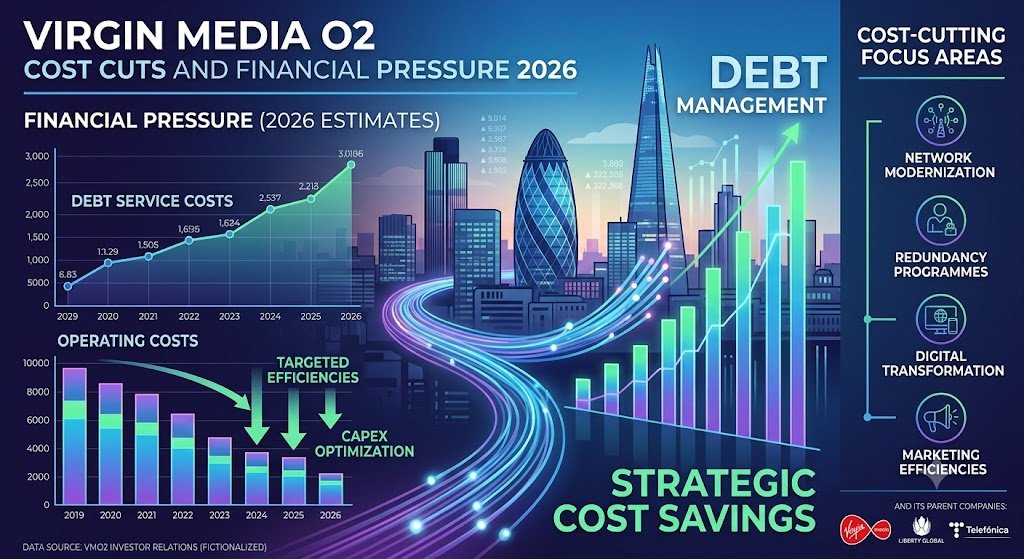
Virgin Media O2 is facing renewed financial pressure as its owners, Liberty Global and Telefónica, consider a cost-cutting programme of around £600 million, according to reporting by the Financial Times. The potential measures come as the UK telecoms company deals with substantial debt, tougher competition from smaller fibre providers and a decline in broadband customers.
The development puts Virgin Media O2 under closer scrutiny from investors and debt markets. The company remains a major player in UK telecommunications, with millions of broadband and mobile customers and a growing fibre and 5G network. However, its latest financial figures show that maintaining growth while investing heavily in infrastructure is becoming more difficult.
Why Virgin Media O2 Is Under Pressure
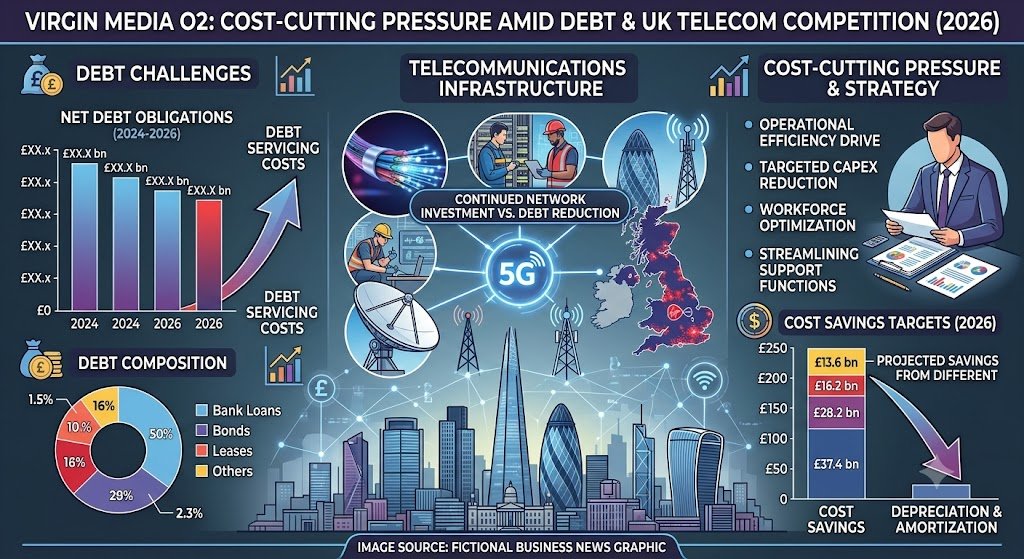
The immediate concern is the company’s cost base and balance sheet. The Financial Times reported that Liberty Global and Telefónica are targeting approximately £600 million in savings, potentially through reductions in jobs, operating expenditure and capital expenditure. The report comes after a significant decline in the value of some Virgin Media O2 bonds, reflecting investor concerns about the company’s debt position.
Virgin Media O2 has accumulated substantial borrowing through network investment, corporate transactions and other financing arrangements. Its financial structure has become an important issue for investors because telecom companies require continuous spending on spectrum, fibre networks, mobile infrastructure, customer service and technology.
At the same time, competition in the UK broadband market has intensified.
Smaller fibre network operators, commonly referred to as alternative networks or “altnets”, have expanded their coverage and compete aggressively on price. This puts pressure on established operators such as Virgin Media O2 and BT Openreach.
Also Read: Petco Loyalty Program Financial Losses Hit Millions After Rewards Redemptions Exceed Expectations
Broadband Customers Have Declined
Virgin Media O2’s customer numbers provide another important part of the financial picture.
According to the company’s second-quarter 2026 results, it had 5.5 million consumer fixed-line customers, after a quarterly decline of 29,900. Total mobile connections stood at 46.4 million, down 17,800 during the quarter.
The company also reported second-quarter service revenue of £2.04 billion, down 3.9% year over year when adjusted for the Daisy transaction. Adjusted EBITDA was £975.2 million, a 2.9% decline on the same basis.
Those numbers do not necessarily indicate an immediate financial crisis, but they demonstrate the challenge facing the business: Virgin Media O2 is investing in future infrastructure while operating in a highly competitive market where customers can increasingly switch between providers.
Virgin Media O2 Is Still Investing
Despite the financial pressure, the company continues to invest heavily in its networks.
Virgin Media O2 said its fibre footprint had reached 9 million premises by the end of the second quarter. It also highlighted its 5G+ network, O2 Satellite service and efforts to improve customer service.
That creates a difficult strategic balance.
Reducing capital expenditure could improve short-term cash generation, but under-investment could weaken the company’s competitive position over the longer term. On the other hand, maintaining high investment while customer growth remains challenging could put additional pressure on cash flow and leverage.
This is one reason cost reductions could become strategically important.
What the Debt Issue Means for Investors
Virgin Media O2’s debt position has become a central concern in the latest investor discussion.
The company’s first-quarter financial release showed a fully swapped third-party debt borrowing cost of 5.3% at March 31, 2026, while the average tenor of third-party debt, excluding vendor financing, was 4.8 years. The company also reported leverage ratios of 4.07 times for net senior debt to annualised adjusted EBITDA and 4.38 times for net total debt to annualised adjusted EBITDA under its relevant covenant calculations.
Higher financing costs matter because even a stable telecom business can face pressure when debt servicing consumes more of its available cash.
For investors and bondholders, the question is therefore not simply whether Virgin Media O2 can generate operating earnings. It is whether those earnings can support network investment, debt repayments, shareholder distributions and the competitive pricing environment at the same time.
Competition Is Changing the UK Telecom Market
The UK’s broadband market has changed significantly as fibre deployment has accelerated.
Alternative network operators have invested heavily in fibre infrastructure and have often competed by offering lower prices or promotional packages. This creates a challenge for established operators with large legacy networks and significant fixed costs.
Virgin Media O2 must therefore defend its customer base while continuing to expand high-speed connectivity.
Its strategy includes combining broadband and mobile services, expanding fibre availability and developing additional mobile services. But those initiatives require capital, while customer acquisition and retention increasingly depend on price and service quality.
What Could Happen Next?
The reported £600 million savings target does not automatically mean that a specific number of jobs will be eliminated or that investment will be reduced by a fixed amount. The Financial Times reported that possible measures include job reductions and lower operating and capital expenditure, while no formal decision on every measure had been publicly confirmed.
Virgin Media O2’s next financial update will therefore be closely watched.
Investors will want to see whether management can stabilise broadband customer numbers, protect earnings and improve cash generation without undermining the company’s long-term network strategy.
The company is also due to publish its third-quarter 2026 financial results on November 3, 2026, according to its investor information.
What It Means for the UK Telecom Sector
The situation at Virgin Media O2 reflects a broader issue across telecommunications.
Network operators must invest billions in infrastructure while customers expect increasingly fast connectivity at competitive prices. Fibre and 5G expansion can create long-term opportunities, but the financial returns may take years to fully develop.
For competitors, suppliers and investors, Virgin Media O2’s response to the current pressure could therefore be significant.
If the company successfully reduces costs while maintaining network investment, it could strengthen its financial position. If savings come at the expense of network quality or customer experience, competitors could gain an advantage.
Also Read: UK International Student Financial Proof: What Applicants Need to Show
Conclusion
Virgin Media O2 enters the second half of 2026 facing a complicated financial environment. Customer losses, heavy debt and aggressive broadband competition are increasing pressure for greater efficiency, while the company still needs to invest in fibre, mobile networks and new services.
The reported £600 million cost-saving programme could become an important part of the company’s financial strategy. The key issue for investors will be whether Virgin Media O2 can reduce costs and strengthen cash generation without sacrificing the infrastructure and customer experience needed to compete in the UK’s telecom market.
FAQs
Why is Virgin Media O2 considering cost cuts?
Its owners are reportedly targeting around £600 million in savings amid concerns about debt, competition and customer losses.
How many fixed-line customers does Virgin Media O2 have?
The company reported 5.5 million consumer fixed-line customers in Q2 2026.
Who owns Virgin Media O2?
Virgin Media O2 is jointly owned by Liberty Global and Telefónica.
Is Virgin Media O2 still investing in its network?
Yes. The company said its fibre network had reached 9 million premises and highlighted continued investment in 5G+ and other services.
When are the next Virgin Media O2 results?
The company says its Q3 2026 financial results are scheduled for November 3, 2026.