
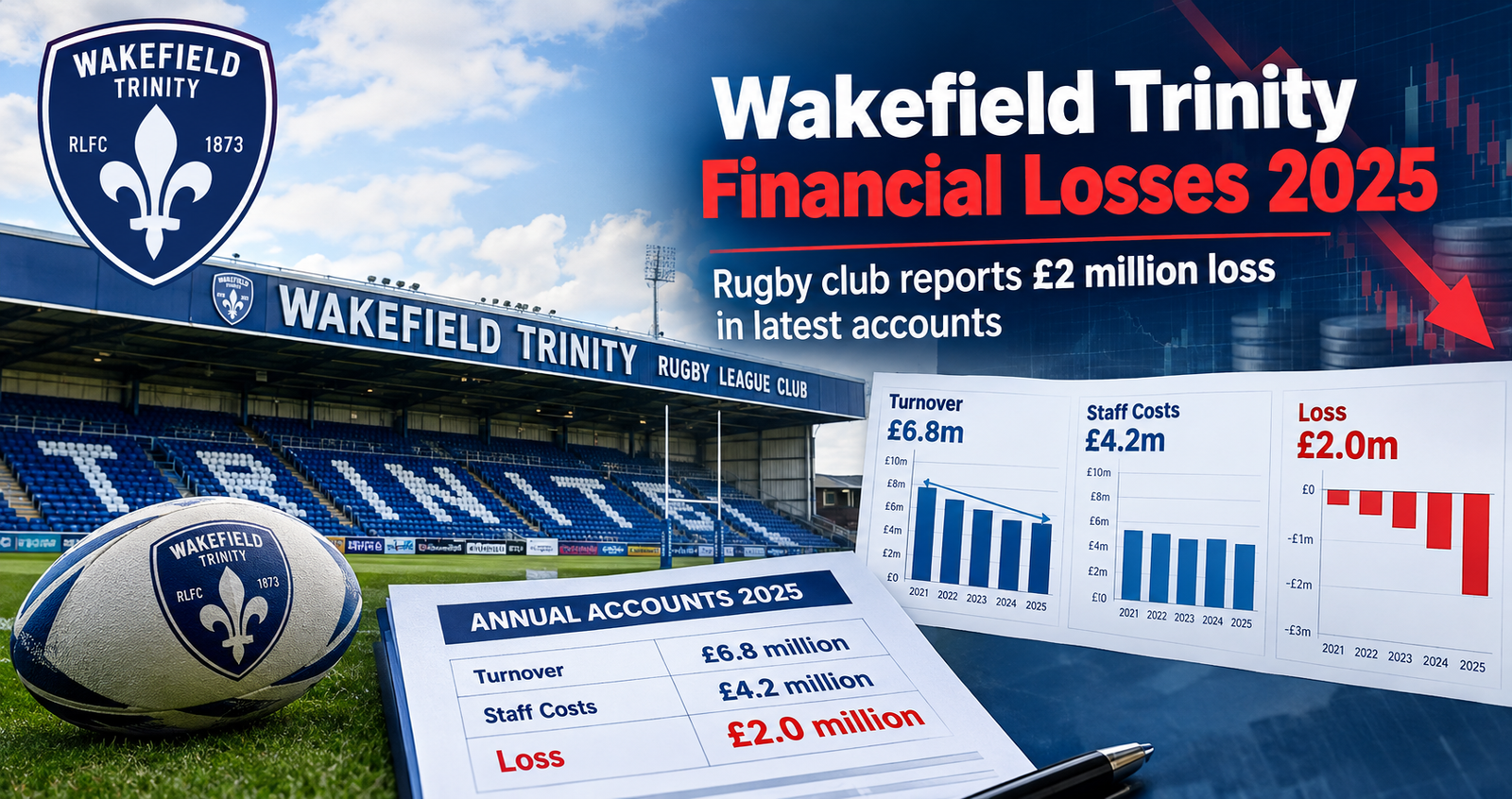
Wakefield Trinity’s financial position has come under renewed attention after its latest available accounts showed the rugby league club recording a loss of around £2 million before tax for the 2024 financial year. The figures are particularly notable because the season was highly successful on the field: Wakefield won the Championship and secured an immediate return to the Super League.
The accounts show a business model under pressure from the cost of competing at the highest possible level. Turnover was reported at approximately £3.5 million, while staff costs were around £4 million, meaning the wage bill alone exceeded annual turnover.
The figures provide an important financial backdrop to Wakefield Trinity’s 2025 Super League campaign and its broader strategy of investment in the club and Belle Vue stadium.
Wakefield Trinity’s Financial Losses in Context
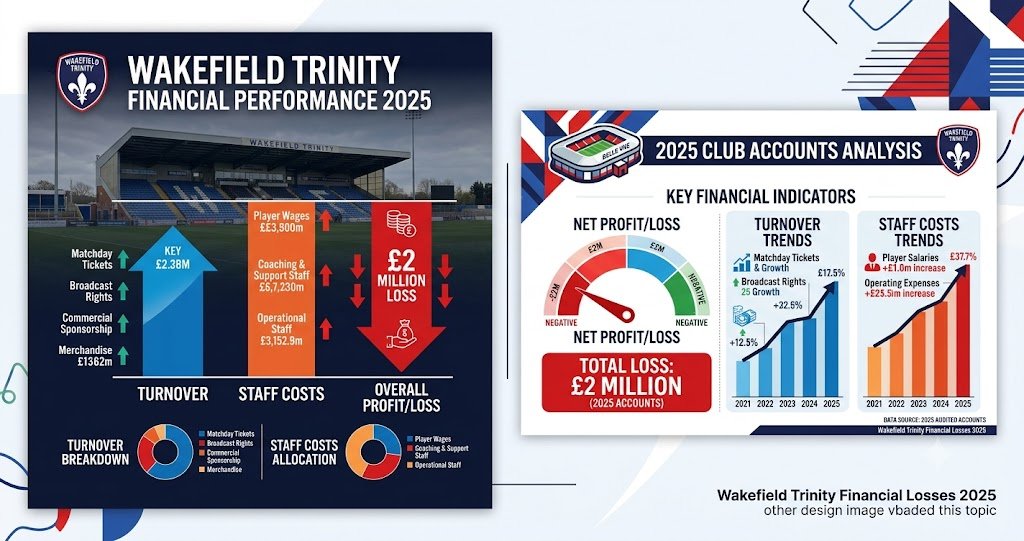
The loss reported for the financial year was approximately £2 million before tax, according to analysis based on Companies House filings. Turnover fell by about 21% to roughly £3.5 million, while staff costs reached approximately £4 million.
Those numbers reveal a fundamental imbalance.
Wakefield spent more on staff than the club generated in total turnover. Other expenses then had to be funded on top of that wage bill, helping explain why the final pre-tax result moved deeply into negative territory.
This does not necessarily mean the club was unable to meet its obligations. A company’s annual loss and its immediate cash position are different financial measures.
Also Read: Springbank Honey Financial Collapse: What We Know About the Company’s Troubles
Why Wakefield Spent So Heavily
The financial figures have to be viewed alongside Wakefield’s sporting ambitions.
The 2024 season was played in the Championship following the club’s relegation from Super League. Wakefield responded with an aggressive push for promotion and ultimately won the League Leaders’ Shield and Championship Grand Final.
That sporting success came with significant expenditure.
The club’s wage bill of roughly £4 million exceeded its turnover, indicating that the promotion campaign required substantial financial backing beyond ordinary operating revenue.
From a business perspective, this resembles an investment strategy: spend ahead of expected future revenue with the expectation that promotion will increase income.
The risk is that promotion is not guaranteed.
Debt and the Balance Sheet
The available analysis of the accounts indicates that Wakefield still had positive net assets of approximately £1.5 million despite the loss. At the same time, estimated borrowings were around £4 million.
That combination is important.
A club can record substantial annual losses while retaining positive net assets, particularly when owners or investors provide funding or when the organisation owns valuable assets.
But borrowings also create future financial obligations. Interest, repayment requirements and operating costs can put additional pressure on a club if expected revenue growth does not materialize.
For Wakefield, returning to Super League was therefore financially important as well as strategically important.
What Changed in 2025?
Wakefield returned to the Super League for the 2025 season after winning promotion from the Championship.
The club subsequently reported improved attendances at its Belle Vue home ground. In June 2025, Wakefield said its average Super League attendance at that point in the season had risen from 5,609 in 2024 to 7,409 in 2025. The club linked the increase to stadium improvements and investment.
Higher attendance can support several revenue streams, including ticket sales, hospitality, food and beverage, merchandise and sponsorship exposure.
However, higher crowds alone do not guarantee profitability.
The financial impact depends on ticket prices, matchday costs, staffing, hospitality income, commercial agreements and the overall cost structure of the organisation.
Wakefield’s Stadium Investment
Wakefield has also been investing heavily in Belle Vue.
The club said redevelopment of the stadium had been a priority since owner Matt Ellis acquired the club in October 2023. Improvements included changes to stands and terracing, digital perimeter boards and other fan-experience upgrades.
The club has argued that these investments are designed to increase attendance, improve the supporter experience and generate additional revenue.
The strategy therefore extends beyond the rugby team itself. The stadium is being treated as a broader commercial asset.
Stronger Sporting Results in 2025
The financial story also changed during the 2025 season.
Wakefield reported that the club remained a Grade A organisation under the IMG grading system and improved its overall score. The club said it recorded a score of 15.4701, up 0.3801 points from the previous year, with finance and stadium performance among the areas contributing to the result.
Wakefield also finished sixth in the 2025 Super League competition and reached the playoffs, according to the club’s October 2025 statement.
That represents a substantial sporting improvement compared with the financial pressures surrounding the previous Championship season.
What the Financial Losses Mean
The central question is whether the club’s investment-led approach can eventually produce sustainable revenue growth.
The 2024 accounts show the cost of the promotion push. Wakefield spent more on staff than it generated in turnover, resulting in a substantial loss.
The 2025 season, meanwhile, provided the club with an opportunity to increase Super League-related revenue, improve attendance and strengthen commercial operations.
The challenge for management is converting that growth into a financial structure in which recurring revenue can cover recurring costs.
Promotion can create new income, but the cost of maintaining a competitive Super League squad can also rise.
Also Read: Social Security Trust Fund: 2034 Depletion Date Explained
Conclusion
Wakefield Trinity’s financial losses provide a useful example of the economics of professional sport. The club’s 2024 campaign delivered promotion and silverware, but it came at a significant financial cost, with staff spending exceeding total turnover and the business recording a substantial pre-tax loss.
The 2025 season offered an opportunity to improve that position through higher-level competition, increased attendances, stadium investment and stronger sporting performance.
The long-term test will be whether those investments produce enough recurring revenue to make Wakefield Trinity’s financial model more sustainable.
FAQs
How much did Wakefield Trinity lose?
The available analysis of the club’s 2024 accounts puts the loss before tax at approximately £2 million.
What was Wakefield Trinity’s turnover?
Turnover was approximately £3.5 million for the financial year covered by the accounts.
Did Wakefield’s wage bill exceed turnover?
Yes. Staff costs were approximately £4 million against turnover of around £3.5 million.
Did Wakefield return to Super League in 2025?
Yes. The club returned to Super League for the 2025 season following its Championship-winning 2024 campaign.
Did Wakefield increase attendance in 2025?
The club reported an average Super League attendance of 7,409 at that point in 2025, compared with 5,609 in 2024.






Woww nice