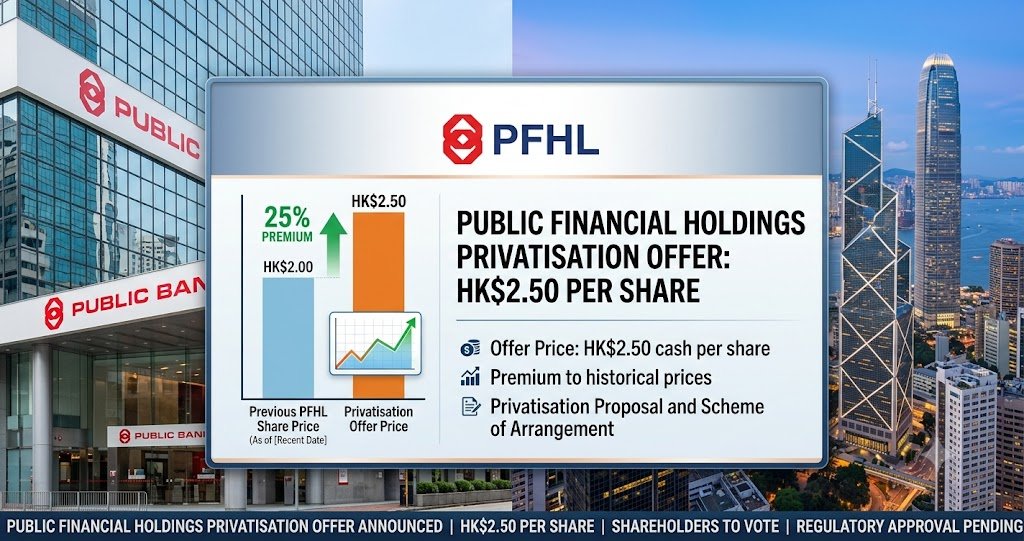
Public Bank Berhad has proposed a public financial holdings privatisation offer that would take its Hong Kong-listed subsidiary Public Financial Holdings Ltd. (PFHL) fully private. The Malaysian banking group is offering HK$2.50 in cash for each PFHL share it does not already own, in a transaction that would cost approximately HK$734.75 million.
Public Bank currently owns 73.23% of PFHL. The proposed scheme would acquire the remaining 26.77% held by minority shareholders and remove PFHL from the Hong Kong Stock Exchange. The announcement was made on September 8, 2026, following a trading halt in PFHL shares.
The proposal is significant because it would simplify Public Bank’s ownership of the Hong Kong business while giving minority shareholders an exit price substantially above the company’s last traded market price.
Also Read: UK International Student Financial Proof: What Applicants Need to Show
What Is the Public Financial Holdings Privatisation Offer?
Under the proposal, Public Bank would acquire the shares in PFHL that it does not already own through a scheme of arrangement.
Public Bank owns approximately 804.02 million PFHL shares, representing 73.23% of the issued share capital. The remaining 293.9 million shares, or approximately 26.77%, are held by other shareholders.
The proposed cash consideration is HK$2.50 per share. Based on the outstanding minority stake, the transaction is expected to involve approximately HK$734.75 million, equivalent to about RM378.6 million based on reported conversion figures.
If completed, PFHL would become a wholly owned subsidiary of Public Bank, and its Hong Kong listing would be withdrawn.
Offer Represents a Significant Premium
One of the most notable elements of the proposal is the premium being offered to PFHL shareholders.
The HK$2.50 cancellation price represents a 61.29% premium to PFHL’s last closing price of HK$1.55 on August 19, 2026, which was the company’s final trading day before the announcement.
The offer also represents substantial premiums against PFHL’s historical trading averages. Public Bank said the price was between 73.61% and 83.82% above PFHL’s average closing prices over various periods extending to 360 trading days.
For minority shareholders, that premium is an important part of the financial case for considering the proposal.
However, the offer price is considerably below PFHL’s reported unaudited consolidated net asset value of HK$7.08 per share as of June 30, 2026. The offer therefore represents a discount of approximately 64.64% to that accounting value.
Why Public Bank Wants to Privatise PFHL
The proposed transaction would give Public Bank complete ownership and control of PFHL.
PFHL operates businesses across banking and financial services, stockbroking, investment property leasing and financing activities. Its operations also include financing and leasing activities connected with taxis and public light buses.
Its banking business includes 29 branches in Hong Kong and one branch in China, according to information published by PFHL.
Taking the company private would allow Public Bank to manage the subsidiary without the requirements and costs associated with maintaining a separate Hong Kong-listed company.
Market commentary has also pointed to the relatively low trading liquidity of PFHL shares as a factor. One report said PFHL’s average daily trading volume over the 12 months before the announcement represented only about 0.027% of issued shares.
What Happens to PFHL Shares?
The transaction is structured as a scheme of arrangement.
If the required conditions are satisfied and the scheme is completed, shares held by minority investors would be cancelled in exchange for the cash consideration. Public Bank would then become the sole shareholder.
PFHL would issue an equivalent number of new shares to Public Bank, credited as fully paid, to maintain its share capital structure. The company’s Hong Kong Stock Exchange listing would subsequently be withdrawn.
The proposal therefore represents more than a simple share purchase. It is a corporate restructuring that would change PFHL from a publicly traded subsidiary into a wholly owned private subsidiary of Public Bank.
What the Offer Means for Investors
For PFHL minority shareholders, the key issue is the difference between the offer price and the company’s historical market valuation and net asset value.
The HK$2.50 price offers a substantial premium to the market price immediately before the announcement. That may make the proposal attractive to investors who have faced limited liquidity in PFHL shares.
At the same time, the discount to reported net asset value is likely to be an important consideration for investors assessing whether the cash offer adequately reflects the underlying value of the company.
Investors should also distinguish between accounting net asset value and the price at which a company can realistically be sold in the public market. A company’s assets may have substantial accounting value without necessarily translating into an equivalent market valuation.
Why the Hong Kong Listing Matters
PFHL’s Hong Kong listing has provided minority investors with access to the company’s shares through a public market.
Removing that listing would eliminate that trading avenue once the transaction is completed.
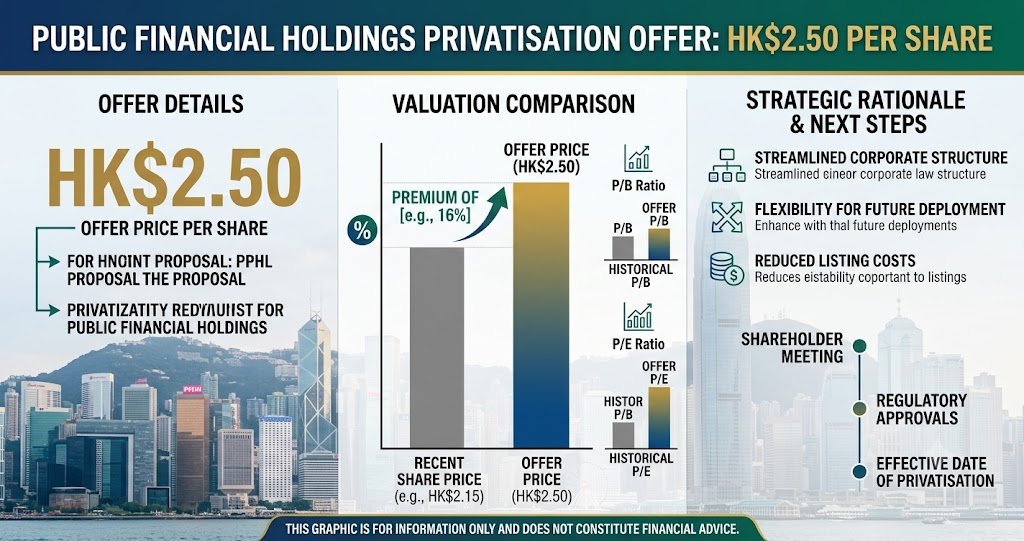
For Public Bank, however, full ownership could provide greater flexibility in managing PFHL’s operations and capital structure. It would also eliminate the need to maintain a minority public shareholder base and a separate listed-company structure.
The strategic impact on Public Bank’s overall earnings is expected to be relatively limited. A September 9 market commentary citing CIMB Securities described the privatisation as strategically positive while suggesting its effect on Public Bank’s earnings would be negligible.
What Investors Should Watch Next
The immediate focus will be on the formal scheme process, shareholder requirements and regulatory or court-related steps necessary to complete the transaction.
The proposal is not the same as a completed acquisition. Investors should therefore distinguish between the announced transaction and its eventual completion.
PFHL shares resumed trading following the announcement, according to the company’s corporate disclosures.
For Public Bank shareholders, the transaction is primarily a question of strategic control and corporate simplification rather than a major earnings transformation.
For PFHL minority investors, the central question is whether the HK$2.50 cash consideration provides an attractive exit compared with the company’s trading history and underlying asset value.
Also Read: HMRC Low Earners Pension Refund: Who Could Receive a Payment in 2026?
Conclusion
The public financial holdings privatisation offer gives Public Bank a path to full ownership of PFHL while offering minority shareholders a substantial premium to the company’s last traded market price. The HK$2.50 proposal, however, remains significantly below PFHL’s reported June 2026 net asset value, making valuation an important consideration for investors.
The next stage will depend on the formal scheme process and the conditions required for completion.
FAQs
What is the public financial holdings privatisation offer?
Public Bank has proposed acquiring the remaining shares of Public Financial Holdings for HK$2.50 per share through a scheme of arrangement.
How much does Public Bank already own?
Public Bank currently owns 73.23% of PFHL.
What premium does the offer provide?
The HK$2.50 offer represents a 61.29% premium to PFHL’s HK$1.55 closing price on August 19, 2026.
Will PFHL remain listed?
If the transaction is completed, PFHL’s listing on the Hong Kong Stock Exchange will be withdrawn.
How much will the transaction cost Public Bank?
The acquisition of the remaining stake is expected to cost approximately HK$734.75 million.